AI Data Centers in South Jersey: Economic Opportunity or Community Concern?

Derek Doernbach, Realtor®
Published October 23, 2026 · 13 min read
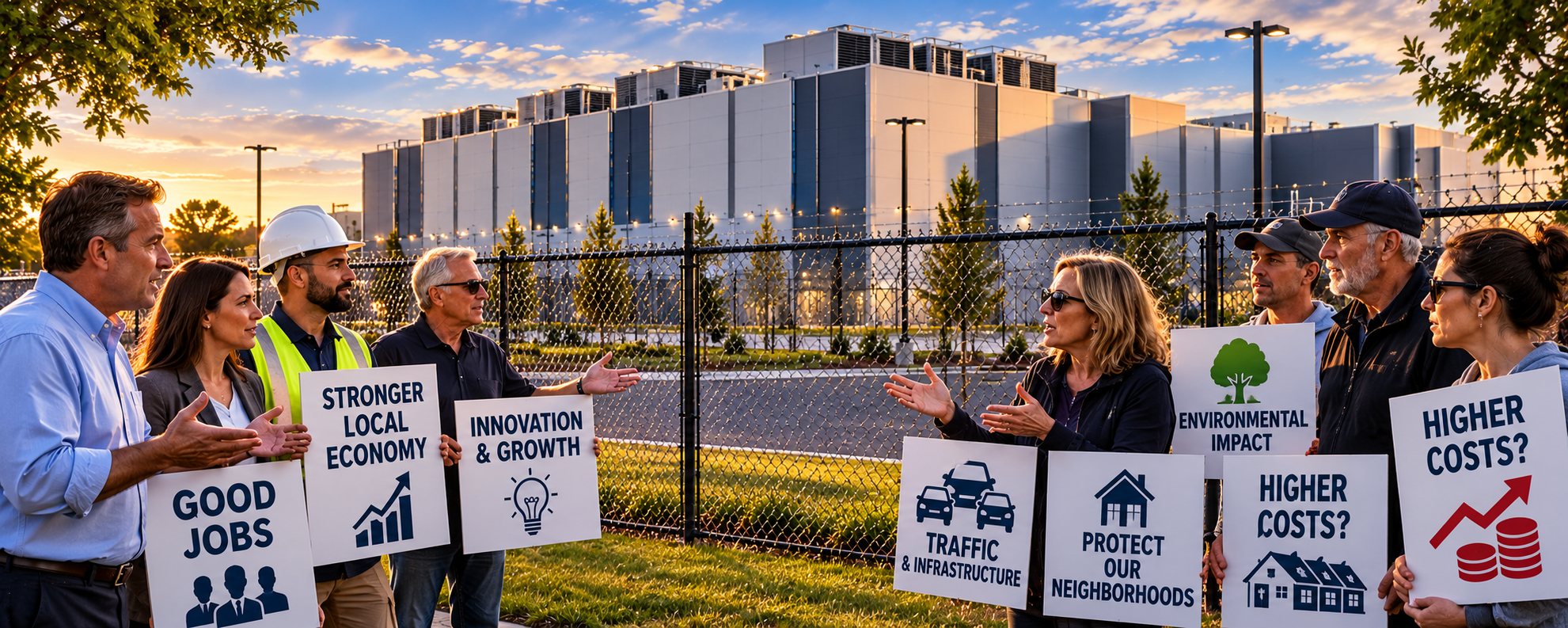
A Debate That Deserves More Than a Yes or No
Artificial intelligence is changing the way Americans work, communicate, conduct business, and access information. Behind that technology is physical infrastructure, including data centers that house the servers, networking equipment, and cooling systems needed to process and store enormous amounts of information.
As demand for AI computing grows, communities across New Jersey are facing difficult questions about where these facilities should be built, who benefits, and who bears the costs.
Supporters point to private investment, construction employment, potential tax revenue, and technological progress. Critics raise legitimate concerns about electricity rates, water consumption, environmental impacts, land use, and whether communities receive sufficient benefits.
Both perspectives deserve consideration.
The central question may not simply be whether data centers are good or bad. It may be whether they can be developed responsibly, with enforceable protections for the communities hosting them.
This guide looks at those questions from a South Jersey perspective, across Atlantic, Cape May, Cumberland, Ocean, Burlington, Gloucester, Camden, and Salem counties. It explains the technology, the trade-offs, the state rules, and the latest public opinion research, and it ends with a community poll, because the people who live closest to these decisions should have a way to be heard.
What Exactly Is an AI Data Center?
At the simplest level, a data center is a building full of computers. Inside, racks of servers process and store information for the websites, apps, businesses, hospitals, banks, and government agencies that rely on digital services every day.
A traditional data center stores and processes information in relatively predictable volumes. An AI data center is built for a different workload. Training and running artificial intelligence models requires enormous computing power, packed into high-density servers that generate far more heat and draw far more electricity than the equipment in a typical office data center.
Every facility depends on the same family of systems:
- Servers and networking equipment, the computers and switches that do the actual work.
- Cooling systems, which remove the heat the equipment produces. The technology varies, and it matters: some systems use large amounts of water, others rely on air, and the choice shapes the facility's impact on the local water supply.
- Backup generators, for the moments when grid power is interrupted.
- An electrical substation or service connection, because a large facility can draw more electricity than a small town.
- Fiber-optic connectivity, the high-speed lines that carry data in and out.
There is no single typical data center. Facilities vary enormously in size, from a modest server room to a multi-building campus, in energy demand, in cooling technology, and in how they sit within a community. Treating every proposal as identical would be a mistake. The right questions depend on the specific project, the site, and the local conditions.
Potential Benefits of Data Center Development
It is worth stating plainly what proponents point to, while remembering that these are possibilities, not guarantees. Every project is different, and what is true of one proposal may not be true of another.
Construction and economic activity. Large projects can support construction trades, electrical contractors, equipment suppliers, engineering firms, and related businesses during the building phase, which can last for years on a large campus.
Permanent employment. Data centers require technicians, engineers, maintenance personnel, security, and operations staff. These are real positions, but permanent staffing is often modest compared with the construction workforce that built the facility.
Municipal tax revenue. Depending on the tax arrangements, exemptions, and development agreements a municipality negotiates, a facility may contribute significant property-tax revenue. The details matter, and they vary widely from one agreement to the next.
Private infrastructure investment. Developers may finance electrical, telecommunications, transportation, or other improvements that a municipality would otherwise have to build itself.
Technological competitiveness. Data centers support services used by businesses, researchers, hospitals, financial institutions, and consumers. New Jersey has announced a statewide plan to attract this industry, in part because state leaders see it as a way to keep the state competitive.
Potential Disadvantages and Community Concerns
It is equally important to take the concerns seriously, because residents are not wrong to ask hard questions.
Electricity demand and utility bills. A large data center consumes electricity at a scale that can rival a small city. It is important to separate the electricity a facility uses from the cost of expanding the grid to serve it. Who pays for new substations, transmission lines, and upgrades? Are residential customers protected from carrying those costs? The answers depend on the utility, the tariff, and the rules in place, which is why these questions belong at the front of any discussion.
Water usage. Water consumption varies by cooling technology, climate, and operating design. Some facilities use large amounts of water, others far less, and some proposals rely on reclaimed water or air-based cooling. Asking what cooling system is proposed and where the water will come from is one of the most important questions a community can raise.
Environmental impacts. Construction means land clearing, grading, and stormwater management. Once operating, a facility's energy use can shape regional energy demand, and backup generators can produce emissions. The energy source, the stormwater protections, and the construction practices all matter.
Noise. Cooling towers, mechanical equipment, and backup generators all make noise. Appropriate noise studies, setback requirements, and mitigation plans can address it, but only if the community asks for them and the developer commits to them in writing.
Jobs versus public costs. It is fair to compare short-term construction employment with long-term positions, and to examine any public subsidies, tax incentives, or infrastructure commitments attached to a project. Community benefits can be genuine, and they can also be modest relative to the scale of the facility.
Land use and neighborhood compatibility. A data center is an industrial use. Zoning, buffers, setbacks, landscaping, lighting, and distance from homes determine how it fits, or fails to fit, with the surrounding neighborhood.
The South Jersey Perspective
These questions are not abstract for South Jersey. Interest in data center development spans the region, and residents of Atlantic, Cape May, Cumberland, Ocean, Burlington, Gloucester, Camden, and Salem counties all have reason to pay attention. No two municipalities face identical impacts, because the electricity grid, water supply, zoning, and neighborhoods differ from place to place.
What Is Being Built in Vineland?
The most visible case study in the region is in Cumberland County, in the City of Vineland. There, the developer DataOne (DataOne Vineland, LLC) is building a hyperscale AI data center of roughly 2.6 million square feet and about 300 to 350 megawatts, as a build-to-suit project for Nebius, which supplies computing capacity to Microsoft. News reports describe the project as part of a reported $17 billion Microsoft deal.
As of October 23, 2026, the project is approved and partly under construction, not merely proposed. Phase 1, a building of about 130,000 square feet, is under construction. Phase 2, an expansion of about 588,000 square feet, was approved by the Vineland Planning Board on August 17 and 18, 2026, by an 8 to 1 vote, after hearings at the Landis Theater that ran to midnight with hundreds of residents attending.
Confirmed Regulatory Action
One enforcement action is confirmed. On August 14, 2026, the City of Vineland issued a stop-work order to parts of the facility, alleging that work began on a liquefied natural gas tank and fuel-cell units before the developer received city approval. This is a confirmed municipal enforcement action; it reflects the city's allegations about the sequence of approvals, not a court finding.
Allegations Under Review, Not Confirmed Findings
Separate from the confirmed enforcement action, journalists and outside groups have raised allegations that remain unresolved. In late August 2026, the non-profit newsroom Floodlight, in reporting carried by The Guardian, used thermal drone footage to allege that the partly completed facility was operating at least 45 of its 62 generators and accused the project of violating federal law over unpermitted generators. These are allegations raised by journalists and outside groups, not adjudicated violations.
The Facility's Proposed Energy Design
The project is designed to generate much of its own power on site. According to the developer's plans and public reporting, the facility plans its own on-site natural gas generation, including about 36 Bergen Engine units with a combined potential of roughly 400 megawatts, which is beyond the data center's 300 to 350 megawatt capacity. The design also includes an LNG storage tank, use of an existing natural gas pipeline, and some power from Atlantic City Electric.
Community Concerns
Local residents and environmental organizations, including the Sierra Club New Jersey, Sustain South Jersey, and local farmers, have raised concerns about the project. Their stated concerns include noise, water use, flooding, property values, and the facility's gas-fired generation. These are public objections and community concerns expressed in hearings and reporting. They are not themselves findings against the developer.
The Developer's Perspective
DataOne has stated expectations about what the project will deliver, including jobs, tax revenue, private investment, and its proposed on-site energy infrastructure. These statements are developer projections, not independently verified outcomes. As with any large development, the figures a developer announces in advance can differ from the results that are later measured, reported, and audited.
Where the Project Stands
As of this article's last-reviewed date, October 23, 2026, the project is approved and partly under construction. Pending allegations and continued community opposition remain open, and approval status and legal and enforcement matters can change. Any administrative, enforcement, or court proceedings related to the project remain pending and unresolved as of the last-reviewed date. A single label cannot capture a facility that is approved, partially constructed, under regulatory review, and facing public objections all at once. Residents should treat each project on its own facts and ask where it stands before drawing conclusions.
For local buyers and sellers watching these debates, it helps to understand the context around a specific town. Our guide to selling a home in Vineland and Millville, Cumberland County explains the local market, and our Cumberland County property tax appeal guide covers how municipal tax changes can affect homeowners.
Could Data Centers Affect Property Values?
This is the question homeowners usually ask first, and it deserves an honest answer: there is no universal answer.
The potential effect on surrounding property values depends on location, noise, visibility, zoning, environmental conditions, and local market characteristics. A data center could affect nearby home values through any combination of these factors:
- Distance from residential properties.
- Visibility, lighting, noise, and traffic.
- Existing zoning and surrounding land uses.
- Potential municipal tax-base changes, which can affect the cost of local services.
- Utility infrastructure and service reliability.
- Environmental and stormwater concerns.
- The overall supply and demand of the local housing market.
Some of these factors point one way, some the other. A well-buffered facility that strengthens a town's tax base could be a net positive for the community overall. A facility that brings noise, traffic, or a visible industrial presence close to homes could be a concern for nearby buyers and sellers.
What the evidence does not support is a single percentage applied to every property near every data center. No defensible universal percentage exists by which a data center will raise or lower nearby home values. Any specific claim that a particular project will change home values by a particular amount should be supported by relevant comparable sales, appraisal research, or credible studies, and it should be treated with healthy skepticism until it is.
For homeowners, the practical takeaway is to ask for specifics, watch the public record, and talk to a local real estate professional about what a particular project could mean for a particular property. If you are considering a sale in the region, our South Jersey market update tracks current conditions county by county.
What Is New Jersey Doing to Regulate Data Centers?
New Jersey moved quickly in 2026 to put rules around the industry, and the pace can be confusing. The important distinction is between laws that are already on the books and the rules, tariffs, and policies still being written to implement them.
The Data Center Fair Share Act (P.L. 2026, c.32; S731/A796) was signed into law by Governor Sherrill on July 7, 2026. The enacted law creates a separate ratepayer class and rate structure for large data centers, generally around 50 megawatts or more. It requires the New Jersey Board of Public Utilities to set standards for electric service to large data center customers, and it includes cost-allocation rules and financial guarantees, including data centers paying at least 85 percent of the supply they request for a minimum of 10 years plus upfront deposits, so that other ratepayers do not subsidize data center grid costs. The law is enacted, but its details are still being implemented: BPU rulemaking is underway, with standards directed to be set within about 12 months, so the specific rates and rules are not yet in force.
Water and energy transparency (P.L. 2026, c.75; S3379/A4096). Signed on August 27, 2026, this law requires data center operators to report their energy and water usage, including total energy consumption, energy used for cooling and for information technology, peak daily water use, water sources, and backup power, to the New Jersey Board of Public Utilities every six months. The first reports are due around November 2026, as part of a three-year reporting program.
Community benefits agreements. The state has issued guidance to municipalities, including the New Jersey Department of Community Affairs Local Finance Notice on Data Centers dated August 25, 2026, explaining how municipalities may negotiate enforceable community benefits with data center developers. A community benefits agreement is only as strong as the contract that is actually signed and enforced, so the specific terms matter.
None of this means every financial or environmental risk has been eliminated. These are enacted laws whose implementing rules, utility tariffs, and policies are still being written, and none of those implementing measures should be treated as already in force. Whether the laws deliver protection in practice depends on the regulations the Board of Public Utilities adopts, the tariffs utilities file, and the agreements municipalities negotiate.
What Does New Jersey Public Opinion Show?
A statewide Rutgers-Eagleton/SSRS poll released October 16, 2026 gives the clearest picture yet of how New Jerseyans feel. The poll was conducted September 24 to 27, 2026, among 1,004 New Jersey adults using the probability-based Rutgers-Eagleton/SSRS Garden State Panel, with a reported margin of error of approximately plus or minus 4.1 percentage points.
The headline findings:
- 72% opposed a data center in their own municipality, including 54% who strongly opposed and 18% who somewhat opposed.
- 21% supported a data center in their municipality.
- 55% said the costs outweighed the benefits.
- 11% said the benefits outweighed the costs.
- 19% said the costs and benefits were about equal.
- 16% were unsure.
A note on interpretation: political affiliation alone does not establish why any individual supports or opposes a data center. Republicans, Democrats, and independents may each support or oppose these projects for legitimate economic, environmental, infrastructure, or community reasons, and party identification alone does not explain any single person's view. The findings are best read as broad statewide caution, not as a verdict on any one party or any one proposal.
One important distinction: this statewide Rutgers-Eagleton/SSRS poll is a scientific, probability-based survey of New Jersey adults with a reported margin of error. It is different from the South Jersey community poll embedded on this page, which is live and now accepting responses. Participation in that poll is voluntary and self-selected, so the results reflect the respondents who choose to take part, not all South Jersey residents. The two are not the same kind of measurement, and their results should not be compared as if they were.
People on both sides of the debate deserve to have their concerns taken seriously. The goal of this article is to present the evidence and the arguments fairly so that readers can reach their own conclusions.
Fifteen Questions Residents Should Ask Before a Data Center Is Approved
Before a planning board or governing body votes, residents can use this checklist to make sure the hard questions get asked. Share it with your neighbors, your municipal officials, and the applicant.
- 1 What is the proposed facility's maximum electrical demand?
- 2 Who pays for the electrical infrastructure needed to serve it?
- 3 Could the project affect existing residential electricity rates?
- 4 What cooling system will it use?
- 5 How much water will it consume, and from what source?
- 6 What noise levels are expected at neighboring properties?
- 7 How many temporary and permanent jobs will be created?
- 8 What property-tax revenue will the municipality actually receive?
- 9 Are any tax incentives or public subsidies involved?
- 10 What environmental and stormwater protections are proposed?
- 11 What setbacks and landscaping buffers will be required?
- 12 What emergency response and backup-power plans are in place?
- 13 Will the developer provide independently verified impact studies?
- 14 What financial guarantees protect residents if the project closes or is never completed?
- 15 What legally enforceable community benefits will the municipality receive?
Conclusion: Responsible Development Starts with Informed Communities
Economic development and community protection do not have to be mutually exclusive.
A responsible discussion of a data center proposal should consider documented benefits, potential costs, local conditions, enforceable safeguards, and meaningful public participation. It should be grounded in the specific project, not in slogans, and it should treat supporters and opponents as neighbors with legitimate concerns.
Informed communities make responsible development possible. The more residents understand what is proposed, what the rules require, and what they can ask for, the better positioned they are to protect their community while still benefiting from growth where it makes sense.
We want to hear where South Jersey stands. Take the community poll below and share this article with a neighbor.
South Jersey AI Data Center Community Poll
Should AI data centers be built in South Jersey? Share your opinion in our anonymous community poll, explore what matters most to other participants, and see how opinions compare across South Jersey counties.
Participation in this poll is voluntary, self-selected, and non-scientific: no login or personal information is required, and the results reflect the respondents who choose to participate, not all South Jersey residents.
The community poll loads right here on this page. If it does not appear, please refresh the page.
South Jersey Speaks
South Jersey Speaks: What's Your Opinion on AI Data Centers?AI Data Centers in South Jersey: FAQ
Quick answers to the questions South Jersey residents ask most often about data center development.
What is an AI data center?
Why are data centers being built in New Jersey?
Do data centers raise electricity bills?
How much water do data centers use?
Do data centers create permanent jobs?
Can a data center affect nearby home values?
What regulations apply in New Jersey?
How can residents participate in local approval hearings?
Sources and Further Reading
This article was last reviewed on October 23, 2026. Facts, legislation, poll findings, and the status of the Vineland project were checked against the primary sources below.
- Data Center Fair Share Act, P.L. 2026, c.32 (S731/A796, New Jersey Legislature) · signed July 7, 2026
- Governor's July 7, 2026 announcement on ratepayer relief and energy legislation (State of New Jersey)
- Data Center Water and Energy Transparency Law, P.L. 2026, c.75 (S3379/A4096, New Jersey Legislature) · signed August 27, 2026
- Governor's August 27, 2026 announcement delivering the data center plan (State of New Jersey)
- NJ Division of Local Government Services, LFN 2026-13: Data Centers (community benefits and local guidance)
- New Jersey Monitor: Data centers must report water and energy use under new law
- Rutgers-Eagleton Poll press releases (data center poll, released October 16, 2026)
- SSRS: More Than Half of New Jerseyans Say Data Center Costs Outweigh the Benefits
- MyCentralJersey.com: Rutgers poll on NJ data centers and AI (October 2026)
- ROI-NJ: Rutgers poll finds 55% of New Jerseyans say data center costs outweigh benefits
- WHYY: Vineland planning board approves 2nd phase of 300-megawatt data center plan (August 2026)
- NJ.com: "You sold us out": NJ town approves next phase of massive AI data center as residents erupt
- WHYY: City of Vineland issues stop-work orders to parts of data center (August 2026)
- The Guardian (reporting by Floodlight): New Jersey data center accused of violating federal law over unpermitted generators (August 2026)
- Sierra Club New Jersey: Sierra Club, Sustain South Jersey and local farmers oppose massive Vineland data center
- NJ.com: This huge AI data center wants to get bigger, and hundreds just packed a NJ hearing to fight it
About the Author
Derek Doernbach is a licensed New Jersey Realtor® with Century 21 Action Plus Realty, part of Your Jersey Shore Team. He has spent the past 10 years helping homeowners throughout South Jersey and the Jersey Shore buy and sell property, and he has closed 192 transactions since obtaining his license in 2016. He has been recognized by the New Jersey Realtors® Circle of Excellence every year since 2019. Derek writes this article as a real estate professional interested in helping homeowners, buyers, sellers, and residents understand how local issues and community developments affect property ownership.
This article is provided for general information only and is not legal, engineering, or regulatory advice. For questions about a specific property, market, or community decision, consult the appropriate local professionals.
Want a clearer picture of what is happening in your South Jersey community and what it could mean for your home? Reach out any time for a straightforward conversation about the local market.