Downsizing at the Jersey Shore: A Complete Guide for Empty Nesters Selling Their Family Home

Derek Doernbach, Realtor®
Published August 27, 2026 · 14 min read
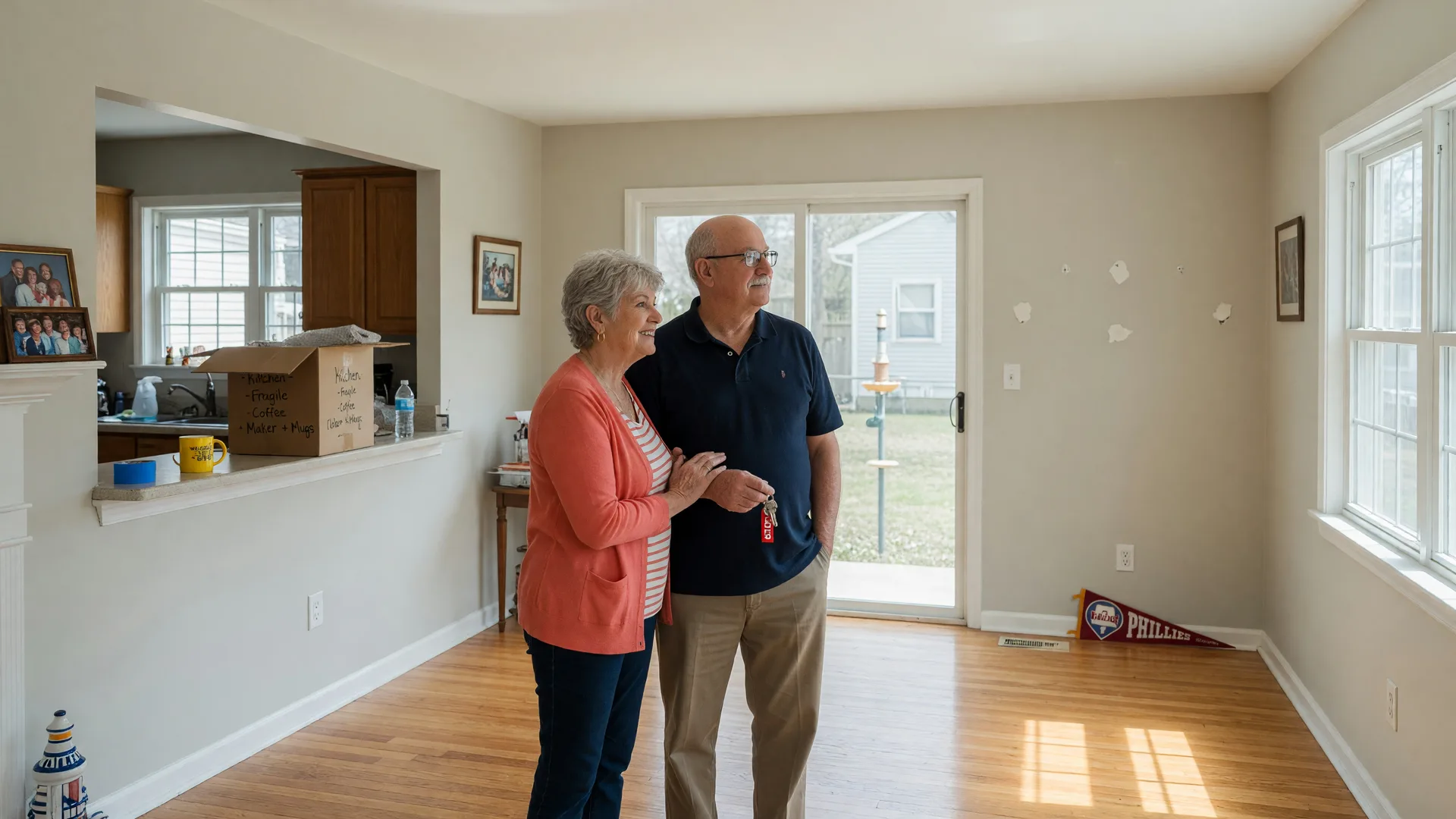
If you raised your children in a four-bedroom colonial in Egg Harbor Township, a split-level in Northfield, or a bayfront home in Somers Point — and now the rooms stay empty, the lawn feels larger than it used to, and the idea of maintaining three bathrooms sounds exhausting — you are not alone. Thousands of empty nesters across Atlantic County, Cape May County, and the Jersey Shore are making the same decision every year: sell the family home and downsize to something that fits their current life.
Downsizing at the Jersey Shore is different from downsizing in most other parts of the country. Property values have risen significantly over the past decade, property taxes remain among the highest in the nation, the housing inventory for smaller single-level homes is tight, and the 55-plus communities scattered throughout Atlantic County offer a lifestyle that many retirees find appealing. At the same time, leaving a home with decades of memories is an emotional process, and the financial decisions involved — capital gains, transfer taxes, senior property tax relief programs — require careful planning.
This guide walks through everything empty nesters and downsizers in South Jersey need to know: when to start planning, how the downsizing market works in Atlantic County, what tax implications to expect, which 55-plus communities are available, how municipal inspections work when selling, and how to handle the emotional side of the transition.
Key Takeaways
- Downsizing at the Jersey Shore typically means selling a larger family home and moving into a smaller single-level home, condo, townhouse, or 55+ community. Many empty nesters stay within Atlantic County to remain near friends, doctors, and familiar communities.
- Married couples can exclude up to $500,000 of capital gains on the sale of their primary residence. Rising shore property values mean some downsizers are approaching or exceeding that threshold for the first time.
- Atlantic County has several established 55+ communities — including Four Seasons at Smithville, The Oaks of Weymouth, The Fairways at Mays Landing, and Traditions at Blueberry Ridge in Hammonton — ranging from the mid-$200,000s to over $600,000 depending on location, size, and amenities.
- New Jersey senior property tax relief programs — including the ANCHOR benefit, Senior Freeze (Property Tax Reimbursement), and the newer Stay NJ program — can provide meaningful savings, but eligibility rules and income limits changed in 2026.
- Start planning 6 to 12 months before your target move date. The best downsizing moves involve thoughtful timing, decluttering well in advance, understanding your next community's rules and fees, and working with an agent who has experience helping empty nesters.
What This Guide Covers
- Why empty nesters downsize at the Jersey Shore
- 55-plus and active adult communities in Atlantic County
- Tax implications for downsizing homeowners
- How the selling process differs for downsizers
- Municipal inspections and certificate of occupancy requirements
- The emotional side of leaving a family home
- Frequently asked questions about downsizing in South Jersey
Why Empty Nesters Downsize at the Jersey Shore
The reasons empty nesters decide to sell and downsize in South Jersey are as individual as the homeowners themselves, but certain patterns come up again and again.
The house is too big. A four-bedroom, two-and-a-half-bath colonial with a full basement and a two-car garage made sense when the kids were home. Once they leave for college or careers, those extra bedrooms turn into storage rooms, the unused living room gathers dust, and cleaning the whole house becomes a weekend-long chore.
The maintenance is too much. The lawn, the landscaping, the gutters, the roof, the HVAC system, the pressure-treated deck — a single-family home generates a continuous stream of upkeep tasks. For homeowners who prefer to travel, pursue hobbies, or simply stop spending weekends on home maintenance, a condo, townhouse, or 55+ community with HOA-managed exterior maintenance offers a simpler alternative.
Property taxes motivate the move. New Jersey property taxes are the highest in the country, and Atlantic County is no exception. A home assessed at $400,000 in Egg Harbor Township comes with an annual tax bill that can run $6,000 to $8,000 or more. Downsizing to a smaller home or a 55+ community with a lower assessed value can reduce that tax burden significantly — and senior relief programs can cut it further.
Life events prompt the decision. Retirement, divorce, the death of a spouse, a health change, or simply the desire to be closer to adult children or grandchildren all push empty nesters to reconsider their housing. The Jersey Shore has strong appeal for retirees who have spent decades in the area and want to stay, but in a home that fits their current stage of life.
The timing can work in the seller's favor. The inventory of smaller single-level homes, condos, and townhouses in desirable Atlantic County communities is often tighter than the inventory of larger family homes. That imbalance can work in a downsizer's favor when they sell their current property — provided they price it realistically and present it well.
55-Plus and Active Adult Communities in Atlantic County
Atlantic County has several established 55+ and active adult communities that attract downsizing empty nesters who want to stay in the area. Here are the major ones:
Four Seasons at Smithville — Galloway Township
One of the largest 55+ communities in Atlantic County, with over 1,200 single-family homes spread across a well-established development near the historic Smithville village. Low-maintenance living with lawn care and snow removal included. The community has a clubhouse, pool, fitness center, and social activities. Home prices typically range from the mid-$300,000s to the mid-$500,000s. Located minutes from Route 9, the Atlantic City Expressway, and shopping on the Consumer Square corridor.
The Oaks of Weymouth — Mays Landing
A gated 55+ community with approximately 625 single-family homes and a 10,000-square-foot clubhouse that includes a fitness center, outdoor pool, tennis courts, and social spaces. Homes range from the $300,000s to over $600,000 depending on size, lot, and upgrades. Located in Mays Landing near the Hamilton Mall and with convenient access to the Atlantic City Expressway.
The Fairways at Mays Landing — Mays Landing
A golf-oriented 55+ community with roughly 465 single-family homes situated around the Mays Landing Country Club. Homeowners have access to golf, a clubhouse, pool, and organized social activities. Home prices typically range from the mid-$200,000s to the mid-$400,000s, making this one of the more affordable active adult options in the county.
Traditions at Blueberry Ridge — Hammonton
A Del Webb community with approximately 134 single-family homes and a private clubhouse with a fitness center, pool, and social calendar. Located in the Blueberry Capital, this community attracts homeowners who want the Pinelands setting and small-town feel of Hammonton with the amenities of an active adult lifestyle. Homes generally range from the $400,000s to the $600,000s.
Tavistock at Mays Landing — Mays Landing
A newer community with approximately 208 attached and single-family homes offering low-maintenance living. The community is still in its active development phase, so new construction options may be available alongside resale homes. Prices vary by phase and floor plan but generally start in the low $300,000s.
Outside Atlantic County, downsizers also look at communities in Cape May County (especially Ocean City, where condos and townhouses with elevator access are popular), Cumberland County (Vineland and Millville have more affordable options), and Ocean County (Beach Haven West, Mystic Island, and Tuckerton offer bayfront and lagoon communities that attract downsizers who want to stay on the water in a smaller home).
Tax Implications for Downsizing Homeowners
The financial side of downsizing involves more than the sale price of your current home and the purchase price of your next one. Several tax rules specifically affect New Jersey homeowners who sell their primary residence and downsize.
Capital Gains Exclusion
Under federal tax law, single homeowners can exclude up to $250,000 of capital gain on the sale of their primary residence, and married couples filing jointly can exclude up to $500,000. To qualify, you must have owned and lived in the home for at least two of the five years before the sale.
For many empty nesters in Atlantic County, this is the first time the gain on their home approaches or exceeds that threshold. A home purchased in the 1990s or early 2000s for $150,000 to $250,000 that is now worth $500,000 to $700,000 or more — not uncommon in desirable shore communities — can generate a gain that pushes a married couple past the $500,000 exclusion. Above that amount, the excess is taxed as a long-term capital gain at federal rates (typically 15% or 20%, depending on income) plus the 3.8% Net Investment Income Tax for higher-income filers.
This is not a reason to avoid downsizing, but it is a reason to calculate your potential gain before you list and to consult a tax professional if you think you might exceed the exclusion.
New Jersey Realty Transfer Fee
New Jersey charges a Realty Transfer Fee (RTF) on most home sales, paid by the seller at closing. The fee is based on the sale price with graduated rates: 0.40% on the first $150,000, 0.67% on amounts from $150,001 to $200,000, 0.78% on amounts from $200,001 to $350,000, and 0.86% on amounts over $350,000. For a home sold at $500,000, the fee is roughly $3,795. For a home sold at $750,000, it is roughly $5,895. For a home sold at $1,000,000, it is roughly $8,095.
Senior Property Tax Relief Programs
New Jersey offers several property tax relief programs that are especially relevant for downsizing seniors:
- ANCHOR Benefit: Provides direct property tax relief to homeowners and renters. Eligibility and benefit amounts vary by income. Applications are filed annually through the New Jersey Division of Taxation.
- Senior Freeze (Property Tax Reimbursement / PTR): Reimburses eligible seniors 65 and older for property tax increases above the amount paid in a base year. Must meet income limits and have lived in New Jersey for at least 10 years. The 2026 income cap was reduced, so checking current eligibility is important.
- Stay NJ Program: Provides up to $6,500 in property tax relief for seniors 65 and older. The 2026 income cap was reduced from $500,000 to approximately $200,000. This program may interact with ANCHOR and Senior Freeze, so applicants should understand which benefit provides the greatest relief.
- Disabled Veterans Exemption: Qualified disabled veterans may be eligible for a full or partial property tax exemption on their primary residence in New Jersey.
The key point for downsizers: moving to a home with a lower assessed value can reduce your property tax base, which then affects your eligibility for freeze and reimbursement programs. If you are currently receiving Senior Freeze based on your old home's taxes, a move resets the base year. A tax professional or the New Jersey Division of Taxation can help you understand how a move affects your specific situation.
How the Selling Process Differs for Downsizers
Selling a home as a downsizer is not fundamentally different from any other home sale — the same attorney review period, inspections, and closing process apply. But there are a few dynamics that specifically affect empty nesters.
Contingent Offers Are Common
Most downsizers need to sell their current home before they can buy their next one. That means their offer on a new property is contingent on the sale of their existing home. In a competitive market, sellers of smaller homes and condos often have multiple offers, and a contingent offer may be less attractive than a non-contingent one. Working with an agent who understands how to position a contingent offer — and knowing whether you can bridge the gap with a bridge loan or home equity line of credit — can make the difference between getting the home you want and losing it to a cash buyer or a buyer without a home to sell.
Decluttering and Depersonalizing Take Time
A family home accumulated over 20 or 30 years holds a lot of furniture, keepsakes, children's belongings, and accumulated possessions. Empty nesters who start the decluttering process six months before listing are in a much stronger position than those who try to do it in two weeks. Staging a downsized, partially empty home to show well to potential buyers is one of the most effective steps a seller can take.
What You Buy Affects When You Sell
Some downsizers decide to buy their next home first, move out, and then list their current home after it is empty. This approach carries carrying costs (two mortgages, two sets of property taxes and insurance) but allows the seller to present a clean, empty home to buyers — which often shows better than a partially furnished home with furniture that is too large for the rooms. Others prefer to sell first and then buy, which avoids double payments but adds the pressure of needing to find a new home on a timeline.
Municipal Inspections and Certificate of Occupancy Requirements
Every town in Atlantic County has its own rules about what must pass inspection before a home sale can close. For downsizers selling a family home — especially an older one — these requirements can uncover issues that need to be addressed before the sale.
Some Atlantic County towns require a full Certificate of Occupancy (CO) inspection before a home can transfer to a new owner. Others require a smoke and carbon monoxide detector inspection only. A few have specific requirements for rental properties but not owner-occupied sales. The differences are significant enough that the guide to municipal inspection requirements in Atlantic County covers each town individually.
For downsizers, the practical takeaway is this: if your home has older systems — a furnace from the 1990s, original windows, an older water heater — and your town requires a CO inspection, those items may or may not need to be replaced before closing. Some towns inspect only for safety hazards; others have broader standards. Knowing what your town requires before you list helps you budget for any necessary repairs and avoid surprises at the closing table.
The Emotional Side of Leaving a Family Home
The financial, legal, and practical aspects of downsizing are straightforward compared to the emotional ones. A family home at the Jersey Shore is not just a structure. It is where children learned to ride bikes, where holiday dinners were hosted, where Thanksgiving turkeys were carved, where birthday parties were celebrated, and where the backyard was the setting for summer barbecues and beach-day prep.
Empty nesters who acknowledge the emotional weight of the move — and give themselves permission to feel it — tend to make better decisions throughout the process. Some practical approaches that help:
- Give yourself time. Start the conversation about downsizing early. The best downsizing moves are planned over 6 to 12 months, not rushed in 30 days.
- Take what matters. You do not need to get rid of everything. The pieces that carry real meaning — the dining table from your parents, the artwork your children made in elementary school, the photographs — come with you. The things that do not matter can be donated, sold, or passed to family.
- Walk through the house with purpose. Before you list, take a room-by-room walk and decide what stays, what goes, what gets donated, and what gets sold. This prevents last-minute panic decisions.
- Consider a downsizing or senior move manager. Professional organizers and move managers who specialize in helping seniors downsize can handle the sorting, packing, coordination, and move-in logistics. They pay for themselves in reduced stress alone.
- Know that the next chapter is good. Less maintenance, lower costs, more time for travel, hobbies, and grandchildren — most empty nesters who downsize report that they wish they had done it sooner.
Frequently Asked Questions About Downsizing in South Jersey
How much does it cost to sell a home and downsize in New Jersey?
Sellers in New Jersey typically pay 5% to 6% in total commissions, the Realty Transfer Fee (graduated based on sale price, roughly $3,700 to $8,000 for most homes), attorney fees ($1,000 to $2,500), and any municipal inspection or certificate of occupancy fees (varies by town, typically $75 to $300). Moving costs and any home preparation or repair expenses are separate. Most of these costs are paid out of the sale proceeds at closing.
Should I sell my current home before I buy my next one?
It depends on your financial situation and the local market. Selling first gives you a cash offer and avoids carrying two mortgages, but means you need to find somewhere to live in between — and you may feel rushed to buy. Buying first lets you move directly from one home to the next but requires qualifying for two mortgages and making two sets of payments until your current home sells. Some downsizers use bridge loans or home equity lines of credit to cover the gap.
Do I pay capital gains tax when I sell my home and downsize?
Not necessarily. Single homeowners can exclude up to $250,000 of gain, and married couples can exclude up to $500,000, provided they have lived in the home for at least two of the past five years. If your gain exceeds those limits, the excess is taxable as a long-term capital gain. The rising value of Jersey Shore homes means more retirees are approaching or exceeding those thresholds than in previous years. A tax professional can run the numbers for your specific situation.
What 55-plus communities in Atlantic County are most popular for downsizers?
Four Seasons at Smithville in Galloway, The Oaks of Weymouth in Mays Landing, and The Fairways at Mays Landing are among the most established and active. Traditions at Blueberry Ridge in Hammonton and Tavistock at Mays Landing are newer options. Each has different price points, amenity sets, and age-restriction policies. The best fit depends on your budget, whether you want golf, how much social activity you want, and how close you need to be to shopping, medical care, and family.
Do I need a real estate agent who specializes in downsizing?
It helps. An agent who has worked with empty nesters understands the emotional dynamics, the contingent-offer process, the importance of timing when there are two transactions to coordinate, and the specific communities and home types that downsizers want. Derek works with downsizing homeowners throughout Atlantic County and South Jersey and can help you plan both the sale of your current home and the purchase of your next one.
How long does the entire downsizing process take?
From the initial decision to the move-in date, plan on 6 to 12 months. The first 2 to 4 months are for planning, decluttering, researching communities, and interviewing agents. The next 2 to 3 months cover listing, showing, and negotiating the sale of your current home. The final 2 to 3 months cover closing on both properties and moving. Each timeline depends on market conditions, how quickly you find a new home, and how complex the transactions are.
Why This Matters for South Jersey Homeowners
The Jersey Shore has one of the oldest populations in New Jersey. Atlantic County, Cape May County, and Ocean County all have a higher-than-average share of residents over 65. As that generation decides whether to age in place or move to a home that better fits their current needs, the inventory of family homes coming onto the market — and the demand for smaller, single-level, low-maintenance properties — will only grow.
For empty nesters, the window to sell a family home and buy a downsized property in the same market is open now. Inventory is still below pre-pandemic levels, but sellers who prepare their homes well and price them correctly are still attracting strong buyer interest. The 55+ communities in Atlantic County have available homes in most price ranges, and the financial tools — from capital gains exclusions to senior property tax relief — can make the math work out well.
The key is not to rush, not to skip the planning phase, and to work with people who understand both the local market and the specific needs of downsizing homeowners.
Thinking About Downsizing at the Jersey Shore?
Let's talk about your timeline, what your home is worth, and what options are available in the communities that fit your lifestyle. No pressure, no obligation — just honest guidance from someone who has helped dozens of empty nesters make this transition.
Derek Doernbach, Realtor®
Derek has been helping homeowners throughout the Jersey Shore navigate real estate since 2016. A recipient of the New Jersey Realtors Circle of Excellence Award every year since 2019, he has closed 192 transactions and specializes in helping empty nesters, downsizers, and families make confident real estate decisions. More about Derek.
Sources and References
- 55places.com — Popular 55+ Communities in Atlantic County, New Jersey. Accessed August 2026.
- New Jersey Division of Taxation — ANCHOR, Senior Freeze (PTR), and Stay NJ program information.
- New Jersey Realtors — Realty Transfer Fee schedule and 2026 legislative updates.
- IRS Publication 523 — Selling Your Home, capital gains exclusion rules.
- Kiplinger — "Downsize in Retirement With 2026 Tax Benefits: 3 Key Strategies." April 2026.
- Matus Law Group — "Who Pays the Mansion Tax in NJ?" Updated April 2026.
- TransferDuty.com — New Jersey Real Estate Transfer Tax Calculator.