Vacant Land Scams in New Jersey: How Fake Owners Target REALTORS®—and How Property Owners Can Protect Themselves

Derek Doernbach, REALTOR®
Published September 3, 2026 · 16 min read
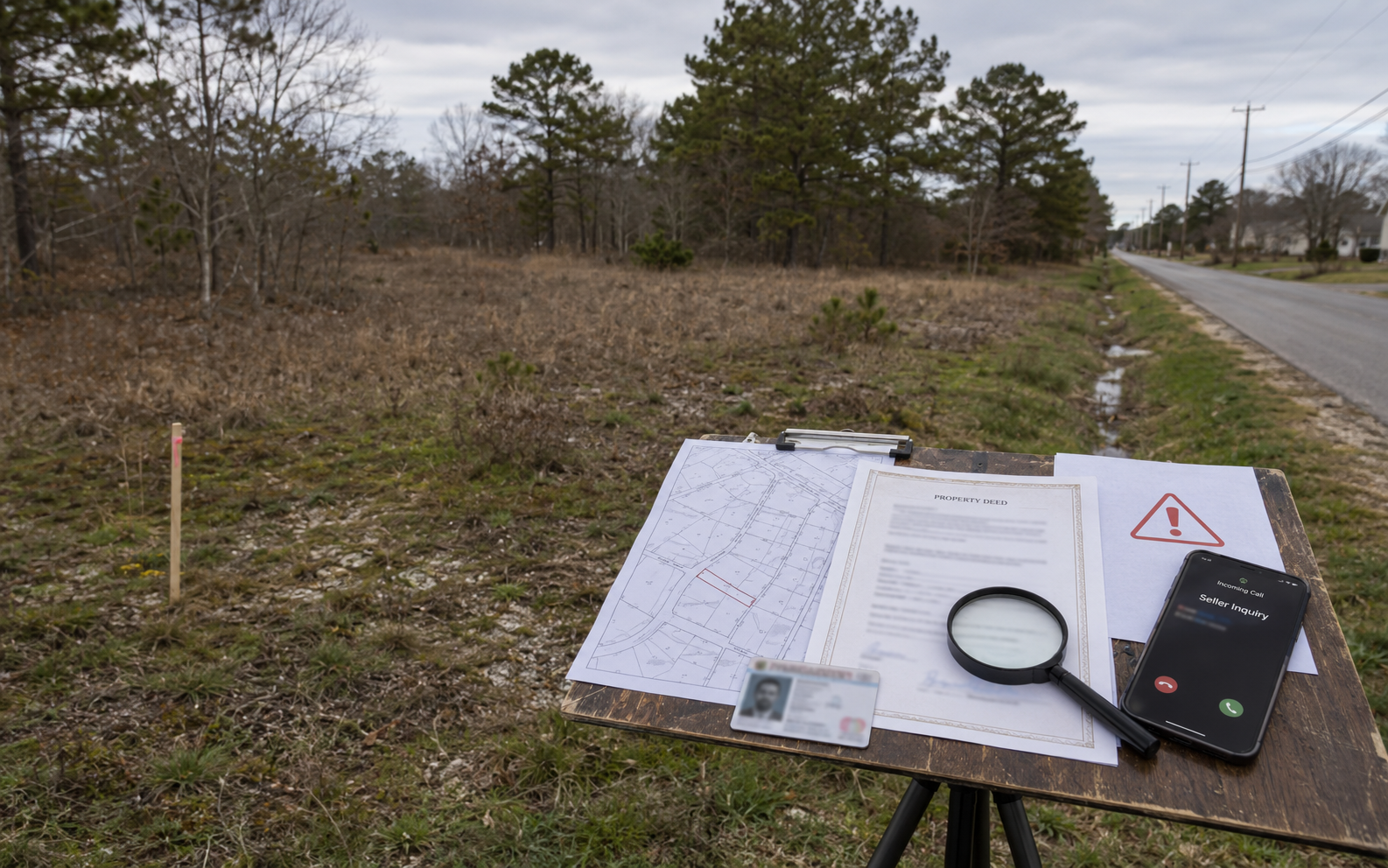
If you own vacant land in New Jersey, there is a pattern you should know about. Since 2023, criminals have been impersonating the owners of vacant and remotely owned property and attempting to sell land they do not own.
These attempts can look surprisingly legitimate at first. A person posing as the owner may already know the real owner's name, the property address, the block and lot, tax-record information, details about the parcel, and just enough about the real estate process to sound convincing.
None of that information is secret. Most of it is a matter of public record.
What is a vacant-land impersonation scam?
A vacant-land impersonation scam is a scheme in which criminals posing as the legitimate owner try to list and sell vacant or remotely owned land without the owner's knowledge.
I am Derek Doernbach, a Jersey Shore REALTOR® serving South Jersey with Century 21 Action Plus Realty and Your Jersey Shore Team. Since 2023, I have personally encountered roughly 12 to 20 suspicious land-sale inquiries, primarily involving properties in Cape May and Atlantic counties. In recent inquiries, Cape May County appears to have been targeted more heavily.
"Receiving an identification card is not the same as independently verifying the property owner."
This article explains how the scam works, what I began seeing in 2023, how the FBI and ABC News have covered the pattern, and what vacant-land owners across South Jersey and the Jersey Shore can do to protect themselves.
How a Vacant-Land Impersonation Scam Works
The basic pattern is consistent. A vacant-land fraud in New Jersey typically plays out something like this:
- A criminal searches public records for vacant or remotely owned land.
- The person collects the real owner's name and property information.
- The person creates a new email address, uses an unverifiable or VoIP telephone number, and may fabricate identification.
- The person contacts a local REALTOR or title company while posing as the owner.
- The person attempts to list the land, frequently seeking a quick or all-cash transaction.
- The person provides remote signatures, questionable notarizations, or payment instructions.
- The person attempts to have the sale proceeds wired to an account under their control or an accomplice's.
- The legitimate owner may not discover the fraud until the property is listed, a sign appears, construction begins, or a deed has already been recorded.
This is not a theoretical concern. On June 16, 2026, the FBI issued a FBI public service announcement warning about criminals impersonating landowners to sell properties they do not own.
The FBI described a familiar toolbox behind these schemes: fabricated driver's licenses or passports, newly created email accounts, VoIP telephone numbers, information gathered from public records, data brokers, compromised accounts or phishing, fictitious deeds or suspicious notarizations, and unrelated or out-of-state accounts used to receive the proceeds.
What I Began Seeing in 2023
I first noticed this pattern in 2023, and I made my 2023 YouTube warning about what I was seeing so that other agents and property owners would be alert to it.
When the inquiries began, I asked the supposed sellers questions about the property and its ownership history. I requested identification and documents that would support ownership.
In one case, a person posing as the owner provided what appeared to be an Ontario, Canada identification card containing real names, but photographs that may have been fabricated. When I asked for the deed, I was told it had burned in a house fire.
I checked the email address being used. It appeared to have been created only recently. The telephone number that was supplied could not be connected to a verifiable property owner.
On another occasion, I examined an email header and obtained an IP geolocation pointing to Nigeria. I also spoke with a person whose claimed circumstances did not appear consistent with the broader information being presented.
The most recent suspicious inquiry I received came through Realtor.com, and the contact was email-only. Taken together, I have encountered roughly 12 to 20 suspicious inquiries over the past three years.
Let me be precise about what these observations do not mean. An IP geolocation is an investigative clue; it does not conclusively prove who sent an email or where the sender was physically located. A person's voice or accent is never proof of fraud.
My concern in these cases came from the complete pattern of inconsistencies: the questionable documents, the unverifiable contact information, and the inability to independently confirm that the purported seller was the record owner.
None of this implies anything about Nigerians, Canadians, foreign property owners, or anyone with an accent. People contact real estate professionals from all over the world for entirely legitimate reasons. My concern is not where someone is from. It is whether the person contacting me can be verified as the person who actually owns the property.
I also do not describe any specific person as a criminal unless that has been officially established. The accurate language is "purported owner," "supposed seller," "person posing as the owner," "suspected impersonation," or "suspicious inquiry." For that same reason, no names, email addresses, telephone numbers, usernames, credentials, ticket numbers, or property addresses from these communications appear here, and I am not reproducing any screenshot.
My Experience Became Part of an ABC News Investigation
After encountering several suspected attempts, I contacted an investigative reporter at ABC News in New York and shared the information and documents I had uncovered.
ABC News interviewed me as part of its investigation into a fraudulent vacant-land sale in North Jersey. I was expected to participate in a related Good Morning America interview that ultimately did not take place. ABC News included my experience and comments in its published investigative report, mentioned me by name, and quoted me. You can read the report here: FBI warns scammers impersonating landowners, ABC News.
Here is what ABC News reported about the North Jersey case: an undeveloped parcel in Randolph, New Jersey was sold without the legitimate owners' authorization. The impostor supplied Ontario driver's licenses bearing the real owners' names, but with false addresses. The property received multiple offers, and the supposed seller quickly accepted a $140,000 cash offer. The transaction closed, and part of the money was transferred before the fraud was discovered.
What stood out to me most: the identification used in that transaction contained the same photograph and address as identification presented to me during three separate suspicious inquiries. I refused to list all three of those properties because I could not independently verify the purported sellers. ABC News quoted me discussing whether the same people, or a larger group, could have been circulating the fabricated identification.
To be clear about my role: I did not personally investigate the Randolph transaction, and I did not stop it. My involvement was identifying similar suspicious inquiries, declining those listings, sharing information with ABC News, and being interviewed and quoted on camera.
How I Handle Suspicious Land-Sale Inquiries
When an inquiry about vacant land does not add up, I slow the process down and work through a verification sequence. It includes:
- Reviewing public ownership and tax records for the property.
- Comparing the information supplied with records I obtain independently.
- Examining whether the email address appears newly created.
- Attempting to determine whether the telephone number can be associated with the actual owner.
- Asking questions about the property and its ownership history.
- Requesting appropriate identification and ownership documents.
- Looking for inconsistencies among the ID, the mailing address, the tax records, and the person's explanation.
- Refusing to rely only on contact information supplied by the purported seller.
- Making every reasonable effort to locate and contact the record owner independently.
- Confirming directly that the legitimate owner actually intends to sell.
The last step matters most. Almost every time I have reached a legitimate owner, they were surprised, and they told me they were not selling their land.
Asking for identification is only one step. A fabricated ID can contain the real owner's name and accurate information copied from public records, which is exactly why I do not treat a photo ID as proof of ownership on its own.
I want to be honest: no process can guarantee that every attempt will be detected, and I am not going to describe proprietary or security-sensitive verification techniques that could be turned into a checklist. The point is that verification is an active process, not a single document.
How I Notify the Local REALTOR® Boards
When a targeted property is in Cape May County, I notify the Cape May County Board of REALTORS. When a targeted property is in Atlantic County, I notify the Atlantic City & County Board of REALTORS, where I currently serve as a Director.
I send an email explaining that I spoke with the actual owner, that the owner did not authorize the sale, and I ask that the address be added to the board's ongoing list of targeted properties. That helps alert other local real estate professionals in case the same person contacts another agent.
Scammers may contact multiple REALTORS across a county. Being rejected by one agent may simply cause the scammer to try another, which is why sharing information matters.
To be clear about what these lists are: they are professional awareness and tracking efforts. The boards do not conduct criminal investigations, they do not guarantee protection, and they do not make legal determinations. Their value is communication. If a property has been flagged, the next agent who is approached has a head start.
Warning Signs That an Inquiry May Be a Scam
No single behavior makes an inquiry fraudulent, but some patterns show up again and again in suspected impersonation cases. A property fraud alert worth heeding is a cluster of these:
- The person communicates only by email or text.
- The telephone number cannot be independently connected to the owner.
- The email account appears newly created.
- The person refuses an in-person or live-video meeting.
- The person repeatedly claims to be traveling, ill, or otherwise unavailable.
- Identification contains inconsistent photographs, addresses, or formatting.
- The person cannot produce ordinary ownership records.
- A deed, survey, tax bill, or other expected document is supposedly unavailable.
- The person knows public information but lacks personal knowledge of the property.
- The person wants to list below market value.
- The person pressures everyone to close quickly.
- The person strongly prefers an all-cash buyer.
- The person requests unusual notarization arrangements.
- The person asks that proceeds be sent to a different person, business, or unrelated account.
Remember the flip side: a legitimate owner can be traveling, prefer email, or want a fast sale. No single warning sign proves fraud. Multiple inconsistencies are what should trigger additional independent verification.
How New Jersey Landowners Can Protect Themselves
You cannot control what criminals attempt, but you can make your land a harder target and give yourself the earliest possible warning. Here are six practical steps, starting with the one that applies to many of the properties I have seen.
1. Keep Property Taxes Current
Many of the properties I have encountered had delinquent taxes. Here is the careful explanation: tax delinquency is visible in public records. A scammer may interpret it as a sign that the land is neglected, or that the owner is deceased, absent, or difficult to locate.
To be clear, delinquent taxes did not cause these scams, and paying your taxes on time does not prevent impersonation or title fraud. Keeping taxes current is simply one sensible way to maintain active oversight of a property you own.
Investigate if tax bills stop arriving, if a balance changes unexpectedly, or if someone else begins paying the taxes on your land. And if you believe your assessment is too high, my South Jersey Property Tax Appeal & Savings Guide explains how the appeal process works.
2. Enroll in a County Property-Recording Alert
Some county clerks offer free notification services that alert owners when documents are recorded under their names. Atlantic County property owners can enroll through the Atlantic County Clerk's Property Fraud Alert. If your land is in Cape May County or another county, check directly with the county clerk where the property is located.
A recording alert is an early-detection tool. It notifies you after a document has been recorded, it does not independently determine whether a document is fraudulent, and it cannot guarantee fraud will be prevented. What it can do is give you the earliest practical warning that something has been filed under your name.
3. Search for the Property Online
Periodically search the property by street address and by block and lot on major real estate websites and relevant local property and listing websites. The FBI also recommends setting up online search alerts for the property, so you are notified when new results appear. If a listing shows up that you never authorized, that is exactly the kind of vacant property scam alert you want to receive early.
4. Visit the Property or Arrange Periodic Checks
Drive past the property periodically, or ask a trusted neighbor, local contact, or property manager to check on it. Look for real estate signs, survey flags, unfamiliar vehicles, people walking the parcel, land clearing, construction equipment, or other unexplained activity.
If you are an absentee owner, make sure a trusted neighbor knows how to reach you and is comfortable reporting anything unusual.
5. Maintain Accurate Records and Contact Information
Securely retain the recorded deed, recent property-tax bills, surveys, your title insurance policy, closing documents, and other ownership records. Then verify that the municipality and county records contain an appropriate current mailing address for you.
Do not publicly display your private personal information. The goal is having your records available to you, not publishing them.
6. Review Title Insurance Coverage
The FBI recommends reviewing your owner's title insurance policy and asking whether it contains post-policy protection involving forgery or related legal costs. I cannot promise that any policy will cover a particular situation.
Title insurance terms vary. Questions about your coverage should be directed to your insurer, your title professional, or a qualified New Jersey real estate attorney.
What Should You Do if Your Land Is Listed Without Permission?
Act promptly, and preserve evidence. Depending on your circumstances, consider contacting:
- The listing brokerage.
- The real estate website displaying the unauthorized listing.
- The county clerk.
- The municipal tax collector.
- Local law enforcement.
- Your title insurer or title professional.
- A qualified New Jersey real estate attorney.
- The FBI Internet Crime Complaint Center (IC3) at ic3.gov.
Preserve emails, full email headers, text messages, telephone numbers, identification documents, contracts, screenshots, notary information, wire instructions, bank information, and any other relevant communications. Do not delete anything. You may need it to show exactly what happened.
If money has already been wired, contact the financial institution and law enforcement immediately. The chance of interrupting or recovering a transfer can decrease quickly.
I am not an attorney, and this is not individualized legal advice. A qualified New Jersey attorney can tell you what makes sense for your specific circumstances.
The Goal Isn't Distrust. It's Verification.
The goal of all of this is not to distrust every remote property owner. Most people who contact a REALTOR about selling property are legitimate, and they have every right to a respectful, efficient process.
Vacant and absentee-owned property simply requires additional attention. Accurate public-record information does not establish identity. A professional-looking ID can be fabricated. And independent contact with the record owner can reveal what convincing-looking documents do not.
Communication matters, too. When REALTORS, title professionals, attorneys, county officials, and law enforcement share what they are seeing, an attempted sale can be stopped before money changes hands.
"Slow the process down, verify beyond the information supplied by the prospective seller, contact the record owner independently and alert the appropriate professional network when a property has been targeted."
If you own vacant land in Cape May County, Atlantic County, or anywhere else along the Jersey Shore and you receive an inquiry you are not sure about, I am glad to help you understand the local real estate process and work through whether the approach is legitimate. No pressure and no obligation. Just a careful look at what is in front of you.
You can reach me at (609) 403-3315 or Derek@YourJerseyShoreTeam.com, or send a note through my contact page. And if you are exploring the area, my Atlantic County community and area guide covers the towns I serve throughout South Jersey and the Jersey Shore.
Frequently Asked Questions
Can someone really sell my land without my permission?
Yes, it has happened. In the North Jersey case ABC News covered, an undeveloped parcel in Randolph, New Jersey was sold without the owners' authorization. That is exactly why owners of vacant and absentee-owned land should stay engaged with their records, enroll in recording alerts, and check on their property.
Why do scammers target vacant land?
Vacant land is relatively easy to impersonate because nobody is there to notice a sign, a listing, or activity on the parcel, and the ownership details a scammer needs, such as the block and lot, are public record. Remotely owned property is an especially common target for the same reason.
Does a county property-recording alert prevent deed fraud?
No. A recording alert is an early-detection tool, not a prevention tool. It notifies you after a document has been recorded under your name so you can act quickly, but it does not block fraudulent documents and it does not independently determine whether a filing is legitimate.
Do delinquent property taxes make land more vulnerable?
They can make a parcel more attractive to a scammer, but they do not cause the scam. Delinquency is visible in public records and may suggest to a scammer that the land is neglected or that the owner is difficult to reach. Paying taxes on time does not prevent impersonation or title fraud, but staying current is one sensible way to maintain active oversight of your property.
What should I do if my land is listed without my permission?
Act promptly and preserve evidence. Contact the listing brokerage, the website displaying the listing, the county clerk, the municipal tax collector, local law enforcement, your title insurer or title professional, and consider filing a report with the FBI's IC3. If money has already moved, involve the financial institution and law enforcement immediately.
How can a REALTOR verify that someone is the actual property owner?
A careful REALTOR compares the information supplied with independently obtained public ownership and tax records, asks about the property and its ownership history, requests appropriate identification and documents, and, most importantly, makes every reasonable effort to contact the record owner directly to confirm they intend to sell.
Is a copy of a driver's license enough to verify a landowner?
No. A photo ID is only one step, and a fabricated ID can carry the real owner's name and accurate information copied from public records. Verification means independently confirming that the person contacting you is the record owner, not simply collecting a document.
This article is provided for general informational purposes and is not legal advice. Anyone facing a suspected fraudulent transfer or recorded document should consult a qualified New Jersey attorney about their particular circumstances.
Derek Doernbach, REALTOR®
Century 21 Action Plus Realty | Your Jersey Shore Team
Derek Doernbach is a Jersey Shore REALTOR® serving South Jersey since 2016. He has closed 192 real estate transactions as a single agent, earned the New Jersey Realtors® Circle of Excellence Award every year since 2019, and serves as a Director with the Atlantic City & County Board of REALTORS. He combines innovative marketing, technology, and direct, honest guidance to help homeowners through buying, selling, and major life transitions. Learn more about Derek on his About page.