Solar Panels in New Jersey: What Buyers, Sellers and Homeowners Need to Know
By Derek Doernbach
Information reviewed October 15, 2026
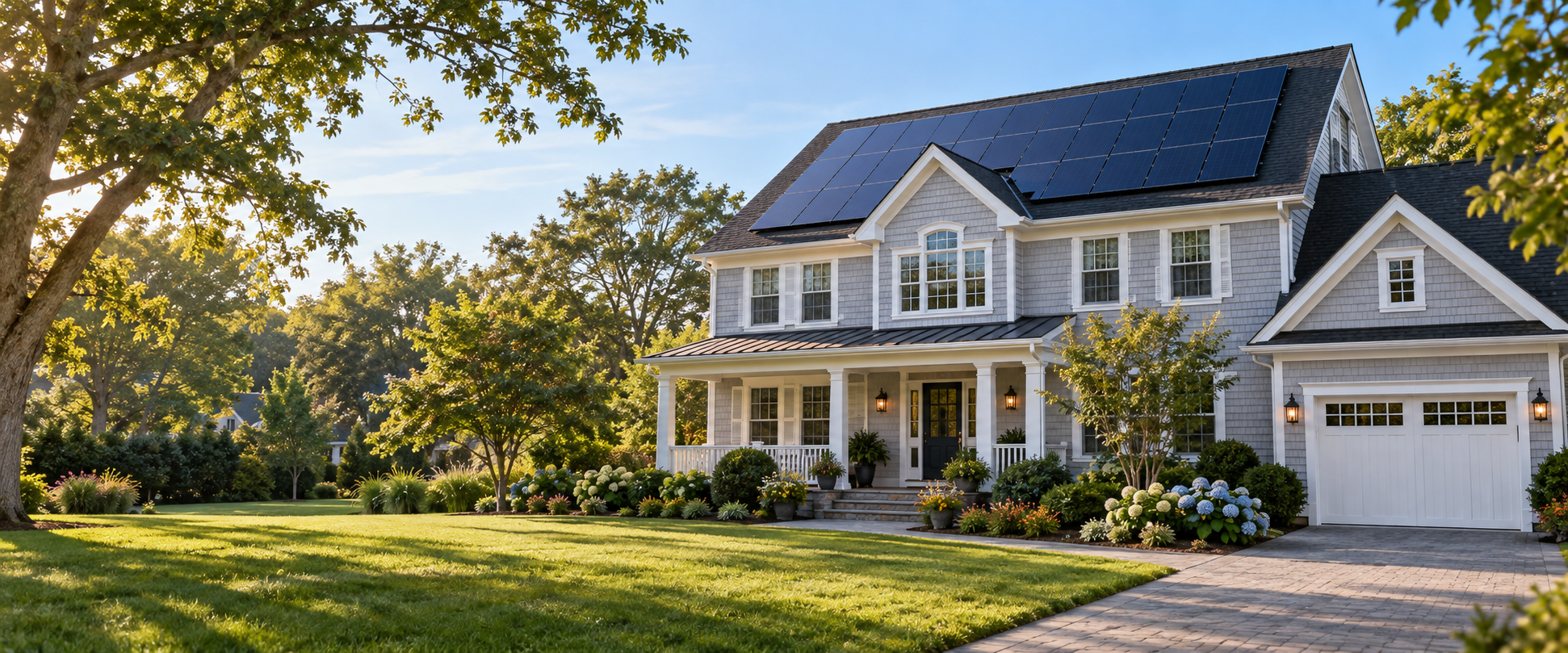
Solar panels can reduce electricity costs and make a home appealing to buyers. But two homes with similar-looking panels can come with very different financial obligations.
One homeowner may own a fully paid-off system and receive incentive income. Another may have a solar loan. A third may be committed to decades of lease payments or electricity purchases from a solar company.
Before deciding whether solar is a benefit, find out who owns the equipment, what the contract requires, and how the actual savings compare with the costs.
This guide explains the main issues for New Jersey homeowners considering solar and for buyers and sellers handling a home that already has it.
Quick answer: Solar can be useful in New Jersey when the property, system costs, and agreement support meaningful savings. Paid-off owned panels generally simplify a home sale. Financed panels require review of the loan and any security interest. A lease generally charges for use of equipment, while a PPA generally charges for the electricity produced. Neither automatically gives the homeowner ownership. Before buying or selling, verify the contract, remaining costs, roof responsibilities, and incentive rights.
What This Article Covers
- Are solar panels worth it in New Jersey?
- Owned solar vs. a solar loan vs. a lease vs. a PPA
- Why annual escalators matter
- Will solar eliminate the electric bill?
- SRECs, TRECs and SREC-IIs explained
- What about solar tax incentives?
- How should homeowners calculate savings and payback?
- Buying a New Jersey home with solar: what to request
- Can a buyer negotiate an existing lease or PPA?
- Selling a home with solar: prepare before listing
- Roof repairs, equipment failures and power outages
- Do solar panels increase home value?
- Frequently asked questions
- Considering buying or selling a solar home in South Jersey?
- Contributing Industry Professional
- Sources and further reading
Are solar panels worth it in New Jersey?
They can be. The answer depends on the property, the price of the system, and the financial arrangement.
A useful evaluation considers:
- Roof age, condition, orientation, and shading.
- Expected annual electricity production.
- Your household's electricity consumption.
- Applicable utility rates and net-metering rules.
- Installation costs or the total lease, PPA, or loan obligation.
- Incentive eligibility and who receives the payments.
- Maintenance, insurance, and equipment replacement costs.
- How long you expect to own the home.
New Jersey has solar incentive and net-metering programs, but participation requirements matter. A sales proposal is not proof that a specific system has been approved.
Solar deserves closer scrutiny when the roof needs replacement, the property has substantial shading, the financing is expensive, or the contract is difficult to transfer.
Owned solar vs. a solar loan vs. a lease vs. a PPA
Owned and paid off
- Who generally owns the equipment?
- Homeowner
- What does the homeowner pay?
- Maintenance and other ownership costs, plus remaining utility charges
- Main issue when selling
- Document ownership, condition, warranties, and incentive rights
Purchased with a solar loan
- Who generally owns the equipment?
- Homeowner, subject to financing and any security interest
- What does the homeowner pay?
- Loan payments, ownership costs, and remaining utility charges
- Main issue when selling
- Resolve payoff, any permitted assumption, and required releases
Solar lease
- Who generally owns the equipment?
- Solar company
- What does the homeowner pay?
- Contractual lease payments, plus remaining utility charges
- Main issue when selling
- Follow transfer, purchase, or termination provisions
Power purchase agreement, or PPA
- Who generally owns the equipment?
- Solar company
- What does the homeowner pay?
- Charges for solar electricity under the contract, plus remaining utility charges
- Main issue when selling
- Review the electricity rate, billing method, escalation, and transfer requirements
These are general descriptions. The signed agreement controls the specific arrangement.
What is a solar lease?
A solar lease lets a homeowner use a solar company's equipment in exchange for contractual payments.
Payments are generally scheduled monthly. Some contracts increase those payments annually. Others offer no annual escalation.
The company owns the panels unless the homeowner later purchases them under an available purchase option.
What is a PPA?
PPA stands for power purchase agreement.
Under a typical residential solar PPA, a company owns the panels and sells the electricity they produce to the homeowner at an agreed price per kilowatt-hour, or kWh.
For example, 800 kWh billed at $0.15 per kWh would cost $120. That is an illustration, not a current price quote. Some agreements use estimated or levelized billing with reconciliation, so read the billing provisions.
A fixed PPA rate does not necessarily mean a fixed monthly bill. Charges may vary with production.
Making PPA payments does not automatically build ownership of the panels. A purchase option, if available, has its own timing and pricing rules.
What does "owned solar" mean?
Owned solar means the homeowner owns the equipment. It does not necessarily mean the equipment is paid off.
Ask two separate questions:
- Who owns the system?
- Is there any outstanding financing or security interest?
A fully paid-off system generally simplifies the transaction, but warranties, monitoring access, utility accounts, and incentive rights still need attention.
Why annual escalators matter
An escalator increases a lease payment or PPA rate according to the contract.
For illustration, a PPA starting at $0.15 per kWh with a 2.9% annual increase would reach approximately $0.258 per kWh in contract year 20. The household's actual bill would also depend on production and billing terms.
A no-escalator option offers more predictable pricing, but compare its starting price and total cost against other offers. A higher starting rate with no escalator is not automatically the best deal.
Jessica Shaak, who contributed industry insight to this guide, emphasized seeking fixed pricing without annual increases and reviewing the full obligation before signing.
For an existing agreement, buyers can ask for better terms. The solar company is not necessarily required to renegotiate.
Will solar eliminate the electric bill?
Not necessarily.
A solar home can still receive utility charges for electricity drawn from the grid and applicable customer or other charges.
New Jersey net metering generally allows eligible customers to receive credits for excess electricity supplied to the grid during the annualized billing period. Remaining excess at the annual settlement is treated differently from ordinary retail credits and is generally compensated using the applicable wholesale avoided-cost framework.
Ask the utility how the property's tariff, annual settlement, and account transfer work.
Net-metering credits and solar renewable energy certificates are separate benefits. One affects utility billing; the other relates to eligible renewable generation.
When reviewing savings, request both the solar bills and utility bills. Looking at only one can give an incomplete picture.
SRECs, TRECs and SREC-IIs explained
These terms refer to different generations of New Jersey solar incentive programs.
A megawatt-hour, or MWh, equals 1,000 kWh. Eligible generation can create renewable energy certificates under the program in which the system is enrolled.
Solar system capacity is commonly measured in kilowatts (kW). Electricity generated or consumed over time is measured in kilowatt-hours (kWh). A 10 kW system does not necessarily produce 10,000 kWh annually; actual output depends on location, orientation, shading, equipment, and other conditions.
The relevant questions are: Which program applies? Who owns the certificate rights? What is the remaining eligibility period?
SRECs: the legacy program
New Jersey's original Solar Renewable Energy Certificate registration program closed to new registrations on April 30, 2020 (NJBPU legacy SREC closure).
Eligible existing systems may continue earning legacy SRECs during their remaining qualification period. Their market value can fluctuate.
Buying a home with an eligible older system does not start a new incentive term.
TRECs: the transition program
Transition Renewable Energy Certificates came from the Transition Incentive program that bridged the legacy SREC program and its successor.
The program uses fixed, factor-based incentives over a 15-year qualification life. The applicable compensation depends on the project's classification and approved terms.
For a resale, obtain the actual certification and payment history instead of assigning a generic TREC value to the system.
SREC-IIs: the successor program
The Successor Solar Incentive program, known as SuSI, includes the Administratively Determined Incentive program, or ADI, for eligible residential projects.
ADI provides fixed incentives over a 15-year qualification period.
As of this article's review date, the published residential incentive is $77 per MWh for registrations received on or after July 27, 2026. Earlier approved registrations can have different rates.
At $77 per MWh, 10 MWh of eligible annual production would generate $770 before applicable fees or adjustments. This is an illustration, not a production or income guarantee.
Always verify the system's approval, assigned rate, eligibility dates, and payment arrangements.
Who gets the incentive money?
The homeowner does not automatically receive it just because the panels are on the roof.
With a lease or PPA, the solar company commonly retains the incentives and environmental attributes. Even an owner who purchased the equipment may have assigned future certificate rights to another party.
Before buying or selling, confirm:
- The specific incentive program and certification number.
- Who owns existing certificates and future generation rights.
- Whether those rights were previously assigned or sold.
- Remaining qualification life.
- Reporting, aggregator, and payment-account requirements.
- Transfer documents and any fees.
- How certificates generated around closing will be allocated.
Equipment ownership and incentive ownership should both be addressed in writing.
What about solar tax incentives?
Federal homeowner credit: an important 2026 distinction
According to current IRS guidance, the federal Residential Clean Energy Credit is not available for property placed in service after December 31, 2025.
A homeowner evaluating a new 2026 installation should not automatically subtract a 30% federal homeowner credit from the price.
Older installations and previously earned credits can present different tax questions. Consult a tax professional about your situation.
A solar company's potential business tax treatment is separate from a homeowner's personal tax-credit eligibility.
New Jersey property tax treatment
New Jersey offers a property tax exemption for qualifying renewable energy systems. The exemption concerns the qualifying increase in assessed value attributable to the system; it does not eliminate the home's existing property taxes.
Ask the local assessor about eligibility and the required application, including Form CRES.
Have the installer and tax professional also explain any applicable New Jersey sales-tax exemption and documentation requirements.
How should homeowners calculate savings and payback?
Compare the total cost of each option using consistent assumptions.
For a purchased system, a basic simple-payback calculation is:
Net upfront system cost ÷ estimated annual net benefit.
Annual net benefit includes electricity savings and incentive income you actually retain, less recurring costs.
A realistic longer-term analysis should also consider financing interest, equipment replacement, production changes, incentive expiration, and the timing of expenses. Do not count financing costs twice.
A six- or seven-year payback may be possible for a particular proposal, but it is not a statewide promise.
For a lease or PPA, compare:
Solar payments + remaining utility bills + other required costs
against:
The estimated utility cost without solar.
Use cautious utility-rate assumptions. Ask to see what happens if electricity rates rise more slowly than the salesperson projects.
For a solar loan, request the cash price, financed price, APR, fees, total payments, and any payment changes tied to a planned principal reduction.
Buying a New Jersey home with solar: what to request
Get the documents early enough for your attorney, lender, and title company to review them before deadlines become a problem.
Ownership and contract documents
- Original purchase, lease, PPA, or financing agreement.
- Every amendment and previous transfer agreement.
- Current payment or electricity rate.
- Remaining term and complete escalation schedule.
- Loan balance and written payoff information, if applicable.
- Transfer requirements, fees, approval conditions, and timelines.
- Purchase, prepayment, renewal, removal, and termination provisions.
System and roof records
- Installation date, equipment specifications, and system size.
- Permit and final inspection records.
- Utility permission to operate.
- At least 12 months of available production and utility history.
- Solar billing history where applicable.
- Equipment, installation, and roof-penetration warranties.
- Repair history and any known roof leaks or system faults.
- Monitoring access and support contacts.
Have the roof and solar equipment evaluated by appropriately qualified professionals. A standard home inspection may not assess all solar components or contract obligations.
Financial and closing review
Ask your professionals to determine:
- Whether the mortgage program accepts the arrangement.
- How solar obligations affect qualification.
- Whether UCC filings or other recorded documents require action.
- Whether a payoff, release, subordination, or other document is needed.
- Whether incentive rights transfer.
- Whether homeowners insurance adequately covers the arrangement.
- Who bears unresolved costs and obligations.
A UCC filing is not automatically the same as a mortgage lien against the whole property. Its meaning and required treatment depend on the documents and financing arrangement.
Fannie Mae permits financing on qualifying solar properties subject to its requirements (Fannie Mae special property eligibility). Leased and PPA equipment is treated differently from qualifying owned equipment for valuation purposes.
Can a buyer negotiate an existing lease or PPA?
A buyer can request:
- A lower rate or payment.
- Removal of future escalators.
- A seller-funded contractual prepayment or buyout.
- A seller concession toward an agreed cost, subject to lender approval and applicable mortgage-program limits.
- Clear allocation of transfer or roof-related expenses.
Whether any request is accepted depends on the contract and the parties.
Prepaying the remaining payments is not necessarily purchasing the system. Obtain written confirmation of who will own the equipment afterward and what obligations remain.
A property offer also does not automatically amend a separate solar agreement. Obtain signed changes and required approvals.
Selling a home with solar: prepare before listing
Solar can be easier to explain when the seller has organized records.
Start by identifying the arrangement accurately. Avoid describing panels as "owned" if what you mean is "the lease is prepaid."
Prepare:
- The complete agreement and amendments.
- Proof of purchase or current loan details.
- Production, utility, and solar billing history.
- Warranty and installation records.
- Incentive-program documents and proof of retained rights.
- Written transfer or payoff instructions.
- Current service and monitoring information.
Contact the provider and any lender early. Ask who starts the transfer, how long approval typically takes, and what is required to release the seller from future obligations.
Before closing, coordinate the utility account, monitoring access, warranties, incentive accounts, and required title documents.
Roof repairs, equipment failures and power outages
Find out who pays to remove and reinstall panels for roof work. Ask about labor, storage, permits, warranty effects, and required contractors.
For owned equipment, review manufacturer and installation warranties separately. A panel performance warranty does not necessarily cover every repair, labor charge, or inverter replacement.
For a lease or PPA, verify maintenance duties and production-guarantee remedies in the agreement.
Also, ordinary grid-connected solar generally shuts down during a utility outage. Backup capability requires appropriately designed equipment, controls, and often battery storage. Confirm which circuits can operate and for how long.
Do solar panels increase home value?
Owned solar can appeal to buyers who want lower operating costs, but there is no guaranteed resale premium.
Age, condition, demonstrated savings, roof condition, remaining warranties, and local comparable sales all matter.
A long lease or PPA presents a different question: will the buyer accept the remaining obligations?
Do not assume installation cost equals resale value or that a buyer will pay extra for every dollar invested.
Frequently asked questions
Is a PPA the same as a solar lease?
No. A lease generally charges for use of equipment. A PPA generally charges for the electricity produced under the agreement. Both commonly involve third-party ownership.
Will I own the panels after the PPA ends?
Not automatically. The agreement may provide purchase, renewal, or removal options. Read the actual end-of-term terms.
Can I buy a home with leased solar using a mortgage?
Potentially. The lender must review the arrangement against the applicable mortgage-program requirements.
Do solar incentives automatically transfer with the house?
Do not assume they do. Confirm ownership of the rights, remaining eligibility, and required program and account transfers.
Does paid-off solar mean free electricity?
It can mean no solar loan, lease, or PPA payment. Utility charges, maintenance, insurance, and future equipment costs may remain.
Can the seller keep the SREC income?
That depends on the existing rights and the transaction agreement. Address incentive ownership explicitly rather than assuming the panels and all related income transfer together.
Is a fixed-rate PPA always the best option?
No. No escalation can improve predictability, but the starting price, total costs, production assumptions, and contract terms still matter.
What if the buyer does not want to assume the agreement?
The parties need to examine contractual purchase, transfer, prepayment, termination, or other permitted options and negotiate responsibility for the costs. Removal or cancellation may not be available simply because the home is being sold.
Considering buying or selling a solar home in South Jersey?
A well-documented solar system can be a useful feature. Understanding its ownership, costs, and transfer requirements helps everyone evaluate it fairly.
Whether you are buying, selling, or considering installation, bring the solar paperwork into the conversation early.
Contact Derek Doernbach with Your Jersey Shore Team at Century 21 Action Plus Realty to discuss how solar fits into your South Jersey real estate plans.
Contributing Industry Professional
Special thanks to Jessica Shaak, owner of Clear Path Title Agency, Inc. in Linwood, New Jersey, and a longtime solar sales consultant with RCL Solar, for contributing practical insight on solar agreements and considerations for buyers and sellers.
For questions about solar installation or available solar options, contact Jessica through RCL Solar:
Phone: 609-839-9556
Email: Jessica@rclsolar.com
This article was prepared by Derek Doernbach using independent research and Jessica's contributed industry perspective.
Sources and further reading
- IRS — Residential Clean Energy Credit
- New Jersey Clean Energy Program — Administratively Determined Incentive Program
- New Jersey Clean Energy Program — Transition Incentive Program
- NJBPU — Closure of the Legacy SREC Registration Program
- NJDEP — Solar Energy
- U.S. Environmental Protection Agency — Solar Power Purchase Agreements
- U.S. Department of Energy — Homeowner's Guide to Solar
- Fannie Mae — Special Property Eligibility Considerations
- NJ Division of Taxation — Property Tax Abatements and Exemptions
Educational information only. Solar contracts, utility tariffs, incentive rules, and financing requirements vary and can change. Consult the appropriate attorney, lender, title professional, tax adviser, utility, and qualified solar professional about the specific property and agreement.