Stick Built vs. Modular vs. Manufactured Homes: What South Jersey Buyers Need to Know

Derek Doernbach, Realtor®
Published July 2025 · 15 min read
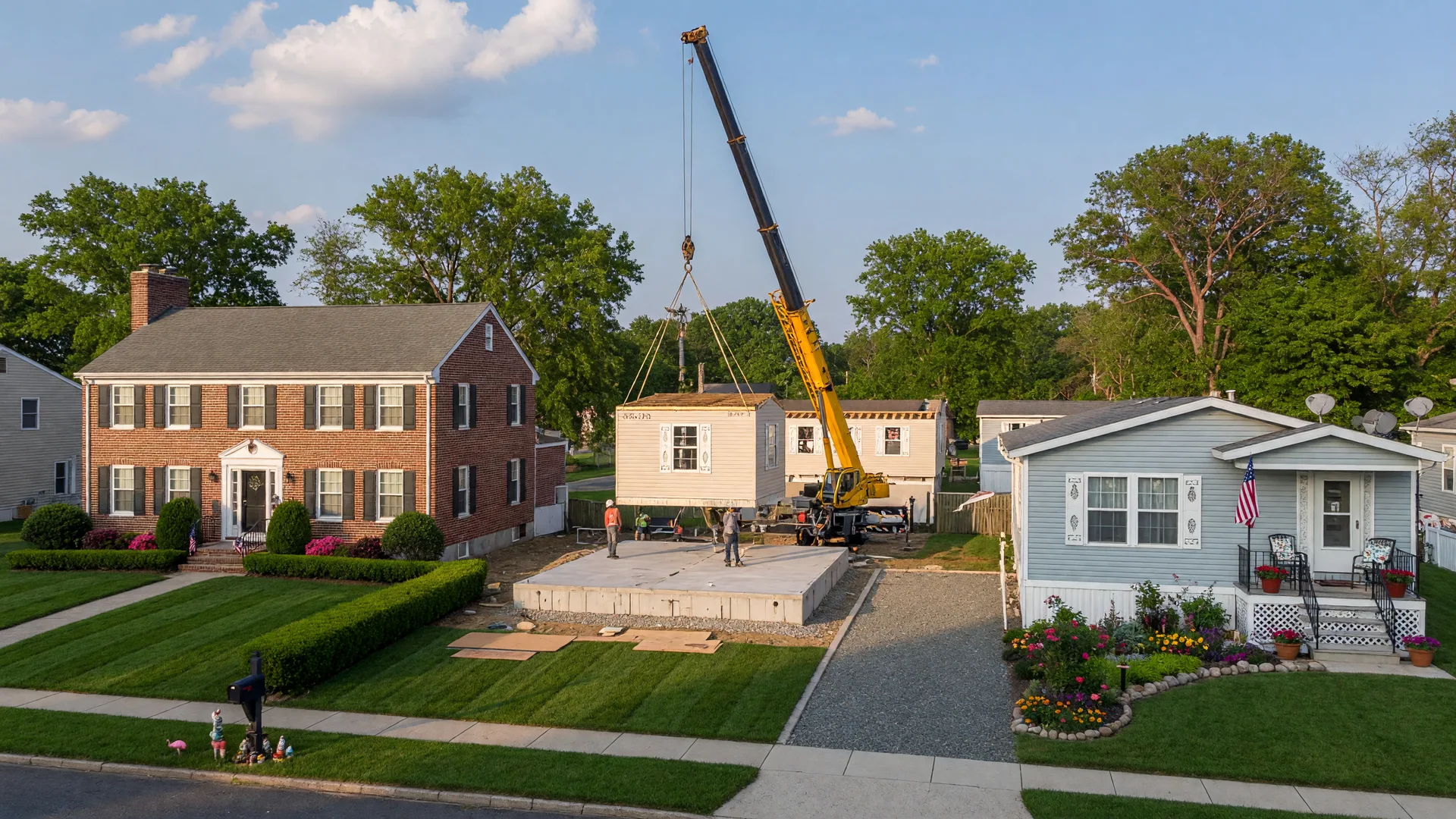
If you are shopping for a home in South Jersey, you may encounter three different types of construction: stick built, modular, and manufactured.
They look different. They are built differently. They are financed differently. And in many cases, they appreciate differently.
Understanding these distinctions matters — especially in Atlantic County, Cape May County, Cumberland County, and along the Jersey Shore, where all three types are common.
This guide explains how each type is constructed, where it can be placed, how it is typically financed, and what buyers should consider before making a decision.
What Is a Stick Built Home?
A stick built home — sometimes called a site-built or traditional home — is constructed entirely on its permanent foundation at the final building location.
Framing lumber is cut and assembled on-site. The foundation is poured or constructed. Plumbing, electrical, and HVAC systems are installed in place. Exterior finishes, roofing, siding, and interior finishes are all completed at the building location.
Most single-family homes in South Jersey are stick built. Whether it is a ranch in Hammonton, a colonial in Galloway, a bungalow in Somers Point, or a beach house in Longport, the vast majority of traditional homes in the region follow this construction method.
Key Characteristics of Stick Built Homes
- Built entirely on-site at the final location
- Constructed on a permanent foundation
- Typically valued highest by appraisers and lenders
- Most familiar to buyers, agents, and lenders
- Generally appreciate over time
- Can be customized extensively during construction
- Subject to local building codes, zoning, and inspections
What Is a Modular Home?
A modular home is built in sections — called modules — inside a controlled factory environment. Those modules are then transported to the building site and assembled on a permanent foundation.
From the outside, a well-built modular home can be virtually indistinguishable from a stick built home. The difference is in the construction process: the home is manufactured in a factory rather than built entirely on-site.
Modular homes must meet the same state and local building codes as stick built homes in New Jersey. The modules are transported on flatbed trucks, lifted into place by crane, and then permanently joined and finished on-site.
Key Characteristics of Modular Homes
- Built in a factory in controlled conditions
- Transported to the site in sections and assembled on a permanent foundation
- Must meet the same New Jersey building codes as stick built homes
- Can be customized during the factory-build process
- Often appraise and sell similarly to stick built homes
- Can be placed on land the buyer owns
- Typically have a shorter overall construction timeline than stick built homes
What Is a Manufactured Home?
A manufactured home — commonly referred to as a mobile home in South Jersey — is built entirely in a factory to federal HUD standards. It is then transported to its final location, typically in a manufactured home community.
This is an important distinction. Unlike modular homes, which are built to state and local building codes, manufactured homes are built to the federal Manufactured Home Construction and Safety Standards (HUD Code), which is administered by the U.S. Department of Housing and Urban Development.
Most manufactured homes in South Jersey are placed in age-restricted (55+) or all-age land-lease communities. In these communities, the homeowner owns the home but leases the land from the community owner. The homeowner pays a monthly lot rent, which may include some combination of property taxes, water, sewer, and trash service — depending on the community.
This land-lease structure is common throughout Atlantic County, Cape May County, Cumberland County, and Ocean County. It is one of the most important distinctions between manufactured homes and other housing types in South Jersey.
Key Characteristics of Manufactured Homes
- Built entirely in a factory to federal HUD Code standards
- Transported to the final location as one or more sections
- Most commonly placed in land-lease communities in South Jersey
- Homeowner typically owns the home but leases the land
- Monthly lot rent is a recurring cost
- Must meet federal HUD standards, not state and local building codes
- Can be placed on land the buyer owns, but this is less common in South Jersey
- May appreciate differently than stick built or modular homes
- Often the most affordable path to homeownership in the region
Side-by-Side Comparison
The table below summarizes the key differences across construction, financing, and ownership.
| Feature | Stick Built | Modular | Manufactured |
|---|---|---|---|
| Where It Is Built | On-site | Factory | Factory |
| Building Code | State/Local | State/Local | Federal HUD Code |
| Foundation | Permanent | Permanent | May be permanent or pier/block |
| Land Ownership | Buyer owns land | Buyer owns land | Usually land-lease (rented land) |
| Typical Financing | Conventional mortgage | Conventional mortgage | Chattel loan or specialized mortgage |
| Appraisal Treatment | Standard | Standard | Different criteria may apply |
| Appreciation | Typically appreciates | Typically appreciates | Varies — may not appreciate like site-built |
| Most Common in South Jersey | Single-family homes | Growing segment | Land-lease communities |
Financing Differences
For a detailed overview of the buying process, including financing options and loan programs available to South Jersey buyers, visit my buying guide.
Stick Built and Modular Homes
Stick built and modular homes in New Jersey are typically financed through conventional mortgages, FHA loans, VA loans, or USDA loans. The buyer purchases the home and the land together, and the property serves as collateral for the mortgage.
Because modular homes are built to the same state and local codes as stick built homes and are placed on permanent foundations, most lenders treat them similarly for mortgage purposes.
Manufactured Homes
Financing a manufactured home in South Jersey is different.
If the buyer is purchasing a manufactured home in a land-lease community, the home itself is not attached to land the buyer owns. This means conventional mortgage financing may not be available.
Instead, manufactured homes in land-lease communities are commonly financed through:
- Chattel loans — personal property loans secured by the home itself, not by real estate
- FHA Title I loans — federal loans specifically designed for manufactured home purchases
- Portfolio loans — loans held by the lender rather than sold on the secondary market
- Manufacturer financing — financing offered by the home manufacturer or dealer
These loans often carry higher interest rates and shorter terms than conventional mortgages. Buyers should carefully compare the total cost of borrowing.
If a buyer purchases a manufactured home and places it on land they own — which is less common in South Jersey but does occur in some rural areas of Cumberland County and Salem County — the home may qualify for conventional or government-backed mortgage financing.
Land Ownership: The Critical Distinction
This section is especially important for South Jersey buyers.
Stick Built and Modular Homes
When you buy a stick built or modular home in South Jersey, you typically own both the home and the land it sits on. You pay property taxes on both the structure and the land. You build equity in both over time.
Manufactured Homes in Land-Lease Communities
When you buy a manufactured home in a South Jersey land-lease community, you own the home but you do not own the land. The land is owned by the community operator. You pay monthly lot rent for the right to keep your home on that land.
This arrangement has significant implications:
- The homeowner does not build equity in the land
- Monthly lot rent is an ongoing cost that can increase over time
- The community may have rules about lot rent increases, pet policies, home improvements, and other matters
- When the homeowner sells the home, the buyer must also be approved by the community and must agree to the lot rent and community rules
- If the community closes or changes ownership, the homeowner may face relocation challenges
- The home may not appreciate in value the same way a home on owned land would
Buyers should understand that manufactured home communities in South Jersey are businesses. The community owner profits from the lot rent. This is a fundamentally different ownership model than purchasing a home on land you own outright.
Pros and Cons of Each Type
Stick Built Homes
Pros:
- Highest resale value and appreciation potential
- Most familiar to lenders, appraisers, and buyers
- Full ownership of land and structure
- Can be customized or renovated freely
- Strongest financing options
- No lot rent or community fees
- Permanent and fully customizable
Cons:
- Highest upfront purchase price
- Longest construction timeline (if building new)
- Subject to weather delays during construction
- May be more expensive in desirable coastal areas
- Requires land ownership (land costs additional)
Modular Homes
Pros:
- Can be more affordable than stick built for similar quality
- Faster construction timeline due to factory conditions
- Built to the same codes as stick built homes
- Can be placed on land the buyer owns
- Typically appraise similarly to stick built homes
- Factory construction reduces waste and can be more energy efficient
- Customization available within factory-build parameters
Cons:
- Transportation and assembly add complexity
- Fewer builders and dealers in some South Jersey areas
- Some buyers may perceive modular homes differently than stick built
- Still requires land purchase
- Financing may require a lender familiar with modular construction
- Long-term appreciation may vary by market
Manufactured Homes
Pros:
- Most affordable path to homeownership in South Jersey
- Lower purchase price than stick built or modular homes
- Often located in established communities with amenities
- Move-in ready much faster than site-built construction
- Monthly lot rent may include some services (water, sewer, trash, taxes)
- Some communities are age-restricted (55+), providing a quieter environment
- Lower maintenance burden on the homeowner
Cons:
- Homeowner does not own the land
- Monthly lot rent is an ongoing cost that can increase
- Chattel loan financing may have higher rates and shorter terms
- Home may not appreciate like a home on owned land
- Community rules and approval processes can be restrictive
- Resale can be more challenging
- If the community closes, the homeowner may need to relocate the home or sell at a loss
- Federal HUD Code standards may differ from state and local building codes
- The home is personal property, not real property, in most land-lease situations
Which Type Is Right for You?
Consider a Stick Built Home If:
- You want to own both the home and the land
- You plan to stay long-term and want maximum appreciation
- You are financing through a conventional mortgage
- You want the freedom to renovate, add on, or customize without community restrictions
- You want the strongest resale value
Consider a Modular Home If:
- You want a quality home at a potentially lower cost than stick built
- You own land (or plan to purchase land) in South Jersey
- You want a faster construction timeline
- You want a home that is built to the same codes as stick built homes
- You want the look and feel of a traditional home with some cost savings
Consider a Manufactured Home If:
- Affordability is your primary concern
- You are comfortable with a land-lease community setting
- You understand that you will pay monthly lot rent and will not own the land
- You want a lower maintenance lifestyle
- You are looking in an age-restricted (55+) community
- You are comfortable with the financing and resale differences
- You have thoroughly reviewed the community's rules, lot rent history, and lot rent increase schedule
South Jersey Market Context
South Jersey's housing market includes all three types in meaningful numbers. To explore specific towns and see what each community offers, visit my Atlantic County community guide.
Stick built homes dominate most residential neighborhoods in Egg Harbor Township, Galloway, Hammonton, Northfield, Linwood, Somers Point, and the surrounding communities.
Modular homes are gaining acceptance, particularly in rural areas of Cumberland County, Salem County, and parts of Atlantic County where land is more available and buyers are looking for cost-effective alternatives.
Manufactured homes are particularly common in Atlantic County, where numerous age-restricted and all-age land-lease communities are located throughout Egg Harbor Township, Galloway, Mullica Township, Buena Vista Township, Hamilton Township, and other inland communities.
Buyers considering manufactured homes in South Jersey should evaluate not just the home itself, but the community — its ownership, its lot rent history, its rules, its amenities, and its long-term viability.
The Bottom Line
Stick built, modular, and manufactured homes serve different buyers with different needs, budgets, and goals.
Stick built homes offer the most traditional ownership model with the strongest long-term appreciation. Modular homes deliver quality construction at a potentially lower cost with the same code requirements as stick built. Manufactured homes provide the most affordable path to homeownership, but the land-lease structure means recurring costs, different financing, and a fundamentally different ownership experience.
The right choice depends on your financial situation, your long-term plans, your comfort level with different ownership models, and the specific South Jersey community where you want to live.
If you are considering purchasing any type of home in South Jersey or along the Jersey Shore, I can help you compare your options, evaluate communities, review financing, and navigate the buying process with confidence.
Derek Doernbach, REALTOR®
Century 21 Action Plus Realty
Thinking about buying a home in South Jersey or along the Jersey Shore? Let's talk about your goals, compare communities, and discuss the best construction type for your needs.
DISCLAIMER
This article is provided for general educational purposes. It is not legal, financial, tax, or construction advice. Housing types, financing options, community rules, and market conditions vary. Consult appropriately licensed professionals regarding your individual circumstances.
Frequently Asked Questions
What is the main difference between a modular home and a manufactured home?
The main difference is the building code and where the home is placed. A modular home is built to state and local building codes and is placed on a permanent foundation on land the buyer owns. A manufactured home is built to federal HUD Code standards and is most commonly placed in a land-lease community where the homeowner does not own the land.
Can I put a manufactured home on land I own in South Jersey?
Yes, it is possible, but it is less common in South Jersey. Most manufactured homes in the region are placed in land-lease communities. If you own land, you may be able to place a manufactured home on it, subject to local zoning requirements and any deed restrictions. Financing may also be more favorable when the home is placed on land you own.
Do manufactured homes appreciate in value?
Manufactured homes may appreciate differently than stick built or modular homes. Homes in land-lease communities may not appreciate as much because the homeowner does not own the land. The lot rent is a recurring cost that can affect resale value. Appreciation depends on the specific community, the condition of the home, and local market conditions.
What is lot rent?
Lot rent is the monthly fee a manufactured home owner pays to the community operator for the right to keep their home on the leased land. Lot rent may include some combination of property taxes, water, sewer, and trash service, depending on the community. Lot rent can increase over time.
Is a modular home the same as a manufactured home?
No. A modular home is built to state and local building codes, transported in sections to the building site, and assembled on a permanent foundation on land the buyer owns. A manufactured home is built to federal HUD Code standards and is most commonly placed in a land-lease community. They are built differently, financed differently, and placed differently.
Can I get a regular mortgage for a manufactured home?
It depends on the situation. If the manufactured home is placed on land the buyer owns and meets certain requirements, conventional or government-backed mortgage financing may be available. If the home is in a land-lease community, financing is typically through chattel loans, FHA Title I loans, or other specialized products — which may have higher rates and shorter terms.