Who Really Controls Mortgage Rates? The President, the Federal Reserve, or the Market?

Derek Doernbach, Realtor®
Published October 3, 2026 · 18 min read
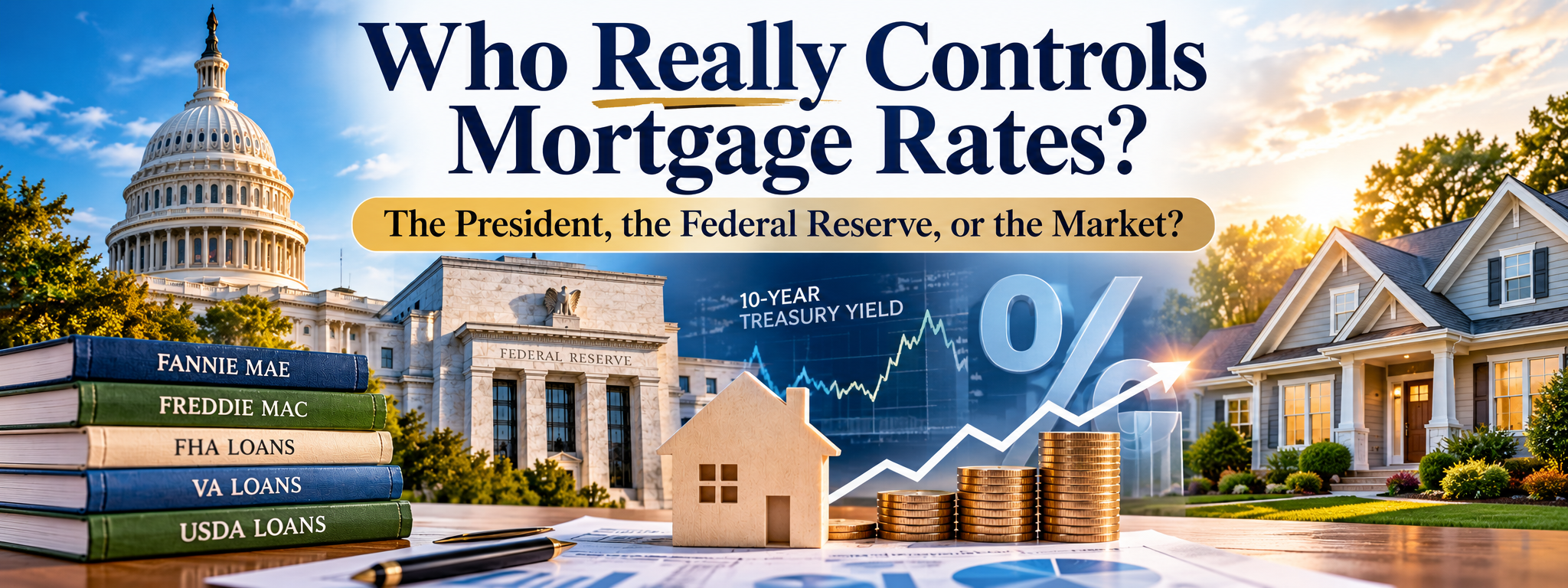
Mortgage rates are not set by the President, Congress, or the Federal Reserve. They are set, every trading day, by millions of investors buying and selling bonds in global financial markets, and the closest single benchmark for the typical 30-year fixed mortgage is the yield on the 10-year U.S. Treasury. The President and Congress can influence the economic conditions markets react to, and the Federal Reserve's policy decisions can shift financial conditions, but none of them directly sets the prevailing market rate on a conventional mortgage. Here is how it actually works, in plain English.
Quick Answers
The Questions Everyone Is Asking, Answered Briefly
- Does the President control mortgage rates? No. The President does not directly set prevailing market interest rates on conventional mortgages and cannot simply order private lenders or financial markets to offer a particular mortgage rate.
- Does the Federal Reserve set mortgage rates? No. The Fed sets a target range for the federal funds rate, a short-term overnight bank rate, not the 30-year fixed mortgage rate.
- What sets the general level of mortgage rates? Global bond markets, anchored most closely to the 10-year U.S. Treasury yield, plus the pricing of mortgage-backed securities and lender margins.
- Why can mortgage rates rise after the Fed cuts rates? Because markets price inflation, growth, and government borrowing, not just the Fed's short-term rate. Long-term yields can rise even when short-term rates fall.
- What determines the rate you are offered? The market sets the general environment; your credit, loan program, down payment, property, occupancy, and lender pricing set your individual rate.
Does the President Control Mortgage Rates?
No. The President does not directly set prevailing market interest rates on conventional mortgages. Mortgage rates are market prices determined by investors who buy and sell bonds, and those investors are spread across the United States and the world. The President cannot simply order private lenders or financial markets to offer a particular mortgage rate.
Presidents from both parties frequently talk about interest rates and economic policy, and those statements often make headlines. It is worth separating political claims from how markets actually work: a president can describe what they want to happen, but the rate you are quoted comes from bond markets, not from the White House. When a president claims credit for lower rates or blames a predecessor for higher ones, that is a political claim, not a description of the mechanism that sets rates.
The same is true in reverse. A president cannot simply "will" rates lower through speeches or pressure, and no amount of public pressure changes the price investors demand for lending money for 30 years.
Does the Federal Reserve Set Mortgage Rates?
No. The Federal Reserve does not set the 30-year fixed mortgage rate, and it does not set the 10-year Treasury yield or the price of mortgage-backed securities. What the Fed does, through its Federal Open Market Committee (FOMC), is set a target range for the federal funds rate, which is an overnight interest rate that banks charge each other for short-term loans of reserves.
This is the single most common misconception in housing news, and even the Federal Reserve Bank of Atlanta has published research calling the presumed direct connection between the fed funds rate and mortgage rates a misconception. Monetary policy influences financial conditions throughout the economy, and those conditions feed into bond markets, but there is no mechanical link that turns a Fed decision into a specific mortgage rate.
The distinction matters: the federal funds rate is a short-term rate, while a 30-year fixed mortgage is a long-term loan. They are priced in different markets, by different investors, for different reasons.
What Is the Federal Funds Rate?
The federal funds rate is the interest rate banks charge one another for overnight loans of reserves held at the Federal Reserve. It is one of the most important short-term interest rates in the U.S. economy because it anchors the cost of short-term money.
The Federal Open Market Committee meets roughly eight times a year and sets a target range for this rate. As of October 2026, the FOMC's target range is 3.75% to 4.00%, following the Committee's decision on September 16, 2026. The Fed then uses open market operations, buying and selling securities, to keep the actual market rate near its target.
Because it is a short-term rate, it most directly affects short-term borrowing: credit cards, home equity lines of credit, some adjustable-rate mortgages, and bank savings rates. It does not directly set the rate on a 30-year fixed mortgage.
What Happens When the Federal Reserve Raises or Lowers Its Target Rate?
When the Fed raises its target, short-term borrowing becomes more expensive, and banks typically pass that along through higher prime rates and costlier credit. When the Fed lowers its target, short-term borrowing becomes cheaper. Those changes ripple through the economy: they influence consumer spending, business investment, bank lending, and the value of the dollar.
But the 30-year fixed mortgage is priced in long-term bond markets, and the Fed's influence there is indirect. A Fed decision changes the backdrop that investors are pricing against: their expectations for inflation, growth, and future policy. Those expectations, not the target rate itself, are what move long-term yields and mortgage rates.
That is why the same Fed announcement can be followed by mortgage rates moving up, down, or barely at all. The market is reacting to what the decision signals, not to the number itself.
Why Can Mortgage Rates Rise After the Fed Cuts Rates?
Because mortgage rates track long-term bond yields more closely than they track the Fed's short-term rate. If the Fed cuts its policy rate at the same time investors grow more worried about future inflation or about government borrowing, longer-term Treasury yields can rise, and mortgage rates can rise with them.
This is not a hypothetical. In September 2024, the Fed cut its benchmark rate by half a percentage point, and the average 30-year fixed mortgage rate rose in the weeks that followed because 10-year Treasury yields climbed. That move was not simply a reaction to the cut itself: subsequent economic data, inflation expectations, expectations about future monetary policy, fiscal conditions and government borrowing, and other market information all contributed to movements in longer-term Treasury yields. The Fed moved short-term rates down; the market moved long-term rates up.
The lesson: "The Fed cut rates, so mortgage rates will fall" is not a reliable prediction. The direction of mortgage rates depends on what bond investors believe about the future, not on the direction of the Fed's last move.
Why Can Mortgage Rates Fall Even When the Fed Hasn't Cut Rates?
Markets are forward-looking. Investors are constantly trying to price what will happen months from now, so mortgage rates often move before the Fed acts, not after. If investors come to believe inflation will cool or economic growth will slow, they buy longer-term bonds, which pushes yields down. Mortgage rates can fall as a result, even with no Fed cut on the calendar.
In practice, mortgage rates frequently decline in anticipation of a Fed move and then barely react when the move actually happens, because the news was already priced in. This is why headlines like "Rates fall ahead of the Fed's decision" are common, and why waiting for a specific Fed meeting to buy a home is usually a misunderstanding of how the market works.
What Role Does the 10-Year U.S. Treasury Yield Play?
The 10-year Treasury yield is the closest single benchmark for the 30-year fixed mortgage rate. The reason is the average life of a 30-year fixed mortgage: because borrowers refinance, sell, or pay extra, the average mortgage is paid off in roughly 10 years, not 30. Lenders and investors therefore price a 30-year fixed mortgage against a 10-year horizon.
But mortgage rates do not simply equal the 10-year Treasury yield. They sit above it by a spread that compensates investors for the extra risks of mortgage lending and covers lender costs. As of early October 2026, the 10-year Treasury yield was around 5.3%, while the average 30-year fixed mortgage rate was 7.28% according to Freddie Mac's Primary Mortgage Market Survey released October 1, 2026. The gap between them reflects mortgage-backed security pricing and lender margins, which we will look at next.
What Are Mortgage-Backed Securities, and Why Do They Matter?
Most conforming mortgages are pooled together into mortgage-backed securities (MBS) and sold to investors around the world. Fannie Mae and Freddie Mac, the government-sponsored enterprises, buy qualifying mortgages from lenders and package them into securities, guaranteeing investors the timely payment of principal and interest on the underlying loans. Their guarantees are not the same as the full-faith-and-credit guaranty of the U.S. government. Separately, Ginnie Mae guarantees mortgage-backed securities backed by federally insured or guaranteed mortgages, such as FHA and VA loans, and Ginnie Mae securities carry the full faith and credit of the U.S. government. When you get a mortgage, your lender typically sells it into this secondary market, and the price investors pay for those securities is part of what determines the rate you were quoted.
Investors demand a premium over Treasuries for mortgage-backed securities because they carry risks Treasuries do not. The biggest is prepayment risk: when rates fall, borrowers refinance and pay off their loans early, which cuts the income investors expected; when rates rise, borrowers hold their loans longer, which extends the securities' duration. There is also some credit risk and the complexity of managing thousands of individual loans.
On top of the MBS yield, lenders add their own margin to cover the cost of originating, processing, and servicing the loan, plus profit. Add it together and you get the full spread between the 10-year Treasury and the average mortgage rate. Historically that total gap has ranged from roughly one to three percentage points, averaging around 1.7 points since the Great Recession. When markets get volatile, that spread can widen on its own, pushing mortgage rates up even when Treasury yields are flat.
How Do Inflation and Inflation Expectations Affect Mortgage Rates?
Bond investors care about the real return they earn after inflation. If inflation is expected to average 3% over the next decade, investors will demand a nominal yield high enough to beat that. When inflation or inflation expectations rise, longer-term yields rise, and mortgage rates follow. When inflation expectations fall, yields can fall even before the Fed does anything.
This is one of the most important indirect channels in the whole system. Government policy, Fed decisions, and market psychology all influence mortgage rates largely by changing what investors believe about future inflation. A policy that credibly lowers inflation expectations can lower long-term rates; a policy that raises them can push rates up, regardless of what the Fed's target rate is doing.
How Can Government Policies Indirectly Affect Interest Rates?
Federal spending, deficits, taxes, tariffs, regulation, and housing policy do not set mortgage rates, but they shape the economic conditions that markets price. Here is how each channel works:
- Federal spending and deficits. Larger deficits usually mean more government borrowing, which means more Treasury supply. All else equal, more supply can push long-term yields up.
- Taxes. Tax policy affects household incomes, business investment, and economic growth, all of which feed into inflation and growth expectations.
- Tariffs. Tariffs can affect the prices of imported goods and inputs, but their ultimate effects on inflation, economic growth, and long-term interest rates depend on factors including their size and scope, exchange rates, supply-chain adjustments, business responses, and monetary policy.
- Regulation. Rules on banks, lenders, and housing finance affect the cost and availability of credit, which influences how lenders price loans.
- Housing policy. The roles of Fannie Mae and Freddie Mac in the secondary mortgage market, along with federally backed programs such as FHA, VA, and USDA loans and Ginnie Mae’s guarantee of qualifying mortgage-backed securities, help shape how the U.S. mortgage market is structured and how credit is made available.
Every one of these works through markets, slowly and indirectly. None of them is a dial that can be turned to produce a specific mortgage rate on a specific day.
Can Congress Take Actions That Indirectly Contribute to Lower Borrowing Costs?
Yes, indirectly. Congress controls fiscal policy: spending, taxes, and the federal debt ceiling. Legislation that credibly reduces deficits or inflation expectations can reduce long-term yields, and policies that support housing finance can help keep mortgage credit available and affordable. Congressional decisions on bank regulation and housing programs also shape the cost of credit.
But Congress does not currently set prevailing market rates on conventional mortgages. Congress can regulate lending and enact laws affecting the cost and availability of credit, but prevailing conventional mortgage rates are generally determined through financial markets rather than established directly by Congress. When members of Congress from either party promise to "lower interest rates" through legislation, what they can realistically affect is the economic backdrop, not the rate itself.
Can a President Take Actions That Indirectly Affect Mortgage Rates?
Yes, indirectly. Presidents influence fiscal policy proposals, regulatory policy, and appointments to the Federal Reserve. Those choices can shift inflation expectations, growth expectations, and market confidence, and through those channels they can nudge long-term yields and mortgage rates over time.
What a president cannot do is lower mortgage rates by announcement, executive order, or public pressure. The rate on your mortgage is the product of global bond markets, and it responds to data and expectations, not to any single person's wishes. Both parties have presidents who have talked about interest rates; the mechanism that sets them has never changed.
Why Can't a President Simply Order Mortgage Rates to Be Lowered?
Because mortgage rates are prices set in decentralized, global markets where trillions of dollars trade every day. No executive order or speech can simply compel millions of independent investors to accept a lower return on their money. Investors lend into the mortgage market because they are paid for inflation and risk; remove that compensation and the money goes elsewhere.
The U.S. mortgage market is funded by investors, not by the government. Roughly two-thirds of new mortgages are sold into the secondary market as mortgage-backed securities. Those securities have to be priced competitively against every other investment in the world. That is why the levers that matter are policy levers that shape economic conditions, and why those levers work slowly and indirectly rather than on command.
Diagram 1
How Government and Fiscal Policy Reach Mortgage Rates
The indirect path from the President and Congress to the rate on your mortgage.
Diagram 2
How the Federal Reserve Reaches Mortgage Rates
Monetary policy moves financial conditions; markets translate those conditions into mortgage rates.
These two systems interact constantly. The arrows show influence, not a guaranteed one-to-one relationship: a change at any step can be amplified, offset, or ignored by the markets downstream. That is why the same Fed decision or the same political headline can produce very different mortgage-rate outcomes at different times.
A Real-World-Style Example: What a Rate Cut Does and Doesn't Do
Here is a simple hypothetical illustration of why mortgage rates and Fed decisions can move in opposite directions. The numbers are made up to make the mechanics clear.
Scenario A: The Fed cuts, and mortgage rates rise anyway
The Fed announces a quarter-point cut to its policy rate. At the same time, investors become more concerned about future inflation and about the size of government borrowing. They sell longer-term Treasuries, the 10-year yield climbs from 5.0% to 5.4%, mortgage-backed security pricing worsens, and the average 30-year mortgage rate rises from 7.0% to 7.3%. The Fed moved short-term rates down; the market moved long-term rates up. Both things happened at once.
Scenario B: Rates fall before the Fed ever moves
Economic data comes in weaker than expected, and investors begin to anticipate slower growth and lower inflation. They buy longer-term Treasuries in advance, the 10-year yield falls from 5.2% to 4.8%, and the average 30-year mortgage rate drops from 7.1% to 6.7%. Weeks later the Fed cuts its policy rate, and mortgage rates barely move, because the market had already priced it in.
The takeaway from both scenarios: the Fed's short-term rate is one input among many, and often not the deciding one. Inflation expectations, growth expectations, government borrowing, and market sentiment can all push mortgage rates around, sometimes against the direction of Fed policy.
What Determines the Actual Rate an Individual Borrower Is Offered?
The market establishes the general rate environment, but the rate you’re offered on a specific loan depends on your individual circumstances and loan characteristics. Two buyers applying the same week can be quoted very different rates. The factors that separate them include:
- Credit profile. Your credit score and history are the biggest individual factors in the rate you are offered.
- Loan program. Conventional, FHA, VA, USDA, and jumbo loans each carry different pricing.
- Down payment and equity. More money down usually means a lower loan-to-value ratio and a better rate.
- Loan-to-value ratio. The size of the loan relative to the home's value affects risk-based pricing.
- Property type. Single-family homes, condos, and investment properties are priced differently.
- Occupancy. Primary residences get better rates than second homes or investment properties.
- Points and lender credits. Paying discount points buys your rate down; taking lender credits raises it.
- Loan term. A 15-year loan almost always carries a lower rate than a 30-year loan.
- Lender pricing. Different lenders have different margins, overhead, and appetite for risk, so quoted rates vary.
This is why shopping lenders matters, and why the "average rate" in a headline is rarely the rate any specific buyer gets.
What Does This Mean for South Jersey and Jersey Shore Buyers and Sellers?
For buyers in Atlantic County, South Jersey, and the Jersey Shore, the practical lesson is simple: do not base a home-purchasing decision solely on a prediction that a President, Congress, or the Federal Reserve will cause mortgage rates to fall. Nobody can reliably promise that, because the people making those predictions do not control the markets that set the rates.
What you can control is your own position: your budget, your credit, your down payment, comparing lenders, and choosing the right home at the right price. A home that fits a buyer's needs may still be worth considering in either a 6% or an 8% rate environment, but affordability and the appropriate decision depend on each buyer's finances, loan options and long-term plans. Waiting for a political promise to play out can mean watching prices and rates move in ways no one predicted.
For sellers, rate headlines affect buyer activity, but the local market is driven by local fundamentals: inventory, pricing, condition, and marketing. A well-priced, well-presented home in Egg Harbor Township, Galloway, Mays Landing, or a shore town like Brigantine or Ocean City attracts buyers in any rate environment. Sellers who understand their local market and price realistically do not need to wait for a national rate story to go their way.
I am a Realtor, not a mortgage lender, financial adviser, or economist, and this article is education, not individualized financial advice. Your specific numbers matter: talk to a lender about what you qualify for, and talk to me about what is happening in your town. Together we can build a plan around facts, not headlines.
Frequently Asked Questions
Does the President set mortgage rates?
No. The President does not directly set prevailing market interest rates on conventional mortgages. Rates are market prices determined by investors in global bond markets, and the President cannot simply order private lenders or financial markets to offer a particular mortgage rate.
Does the Federal Reserve set mortgage rates?
No. The Fed's FOMC sets a target range for the federal funds rate, an overnight interbank rate. The 30-year fixed mortgage rate is set in long-term bond markets and is not directly controlled by the Fed.
Will mortgage rates automatically fall when the Fed cuts rates?
No. Mortgage rates track long-term bond yields, which respond to inflation expectations, growth expectations, and government borrowing. Rates have risen after Fed cuts and fallen before Fed cuts; there is no automatic relationship.
What does the 10-year Treasury have to do with mortgages?
The 10-year Treasury yield is the closest benchmark for the 30-year fixed mortgage because the average life of a 30-year fixed mortgage is about 10 years. Mortgage rates move with 10-year yields but sit above them by a spread for mortgage-specific risk and lender costs.
Can Congress lower mortgage rates?
Not directly. Congress controls fiscal policy, and legislation that credibly lowers deficits or inflation expectations can reduce long-term yields over time. Congress can also regulate lending and enact laws affecting the cost and availability of credit, but prevailing conventional mortgage rates are generally determined through financial markets rather than established directly by Congress.
Can government policies affect mortgage rates?
Yes, indirectly. Spending, deficits, taxes, tariffs, regulation, and housing policy shape inflation expectations, growth, and the cost of credit, all of which feed into bond markets and, eventually, mortgage rates.
Why are mortgage rates different from the federal funds rate?
The federal funds rate is a short-term overnight rate between banks. A 30-year fixed mortgage is a long-term loan priced in long-term bond markets against the 10-year Treasury, mortgage-backed securities, and lender margins. Different markets, different time horizons, different rates.
Why do different buyers receive different mortgage rates?
Because lenders price each loan individually. Credit score, loan program, down payment, loan-to-value ratio, property type, occupancy, points, loan term, and lender pricing all affect the rate a specific borrower is offered.
Should I wait for mortgage rates to fall before buying a home?
That is a personal financial decision, not one anyone can answer with a rate prediction. Nobody reliably knows where rates are headed, and waiting on a political or Fed prediction can mean missing the right home. Compare your own numbers with a lender and decide based on your situation, not a headline.
Derek Doernbach, Realtor®
Century 21 Action Plus Realty · Your Jersey Shore Team
License #1645208 · Serving South Jersey since 2016
I have helped homeowners across Atlantic County and the Jersey Shore buy and sell homes since 2016. My job is to help you understand the local market, price your home correctly, market it effectively, and make decisions you feel good about. If you are wondering what today's rate environment means for your specific town, your home, or your budget, let's talk.
Sources and References
- Freddie Mac : Primary Mortgage Market Survey (30-year fixed mortgage rate, October 1, 2026)
- Federal Reserve Bank of St. Louis : What Determines Mortgage Rates?
- Fannie Mae : What Determines the Rate on a 30-Year Mortgage?
- Ginnie Mae : Funding Government Lending (MBS guaranty and full faith and credit)
- Federal Reserve Bank of Atlanta : Not Joined at the Hip: The Relationship Between the Fed Funds Rate and Mortgage Rates
- Federal Reserve Bank of Boston : Why Mortgage Rates Exceed Treasury Yields
- Federal Reserve : Federal Open Market Committee and the Federal Funds Rate
- Federal Reserve : FOMC Statement, September 16, 2026
- FRED, St. Louis Fed : 10-Year Treasury Constant Maturity Yield (DGS10)
- FRED, St. Louis Fed : Federal Funds Target Range Upper Limit (DFEDTARU)
Related Reading
- Should You Buy a Home in South Jersey Right Now?
- Shopping for a Mortgage in New Jersey? 30 Questions to Ask Before Choosing a Lender
- What First-Time Buyers Need to Know Before Touring Homes in New Jersey
- NJHMFA Mortgage Rates and First-Time Buyer Programs
- How to Sell Your South Jersey Home for the Most Money
- South Jersey Housing Market Update