Why Do We Say "Wooder"? The South Jersey Pronunciations That Identify a Local
Derek Doernbach, Realtor®
Published September 7, 2026 · 14 min read
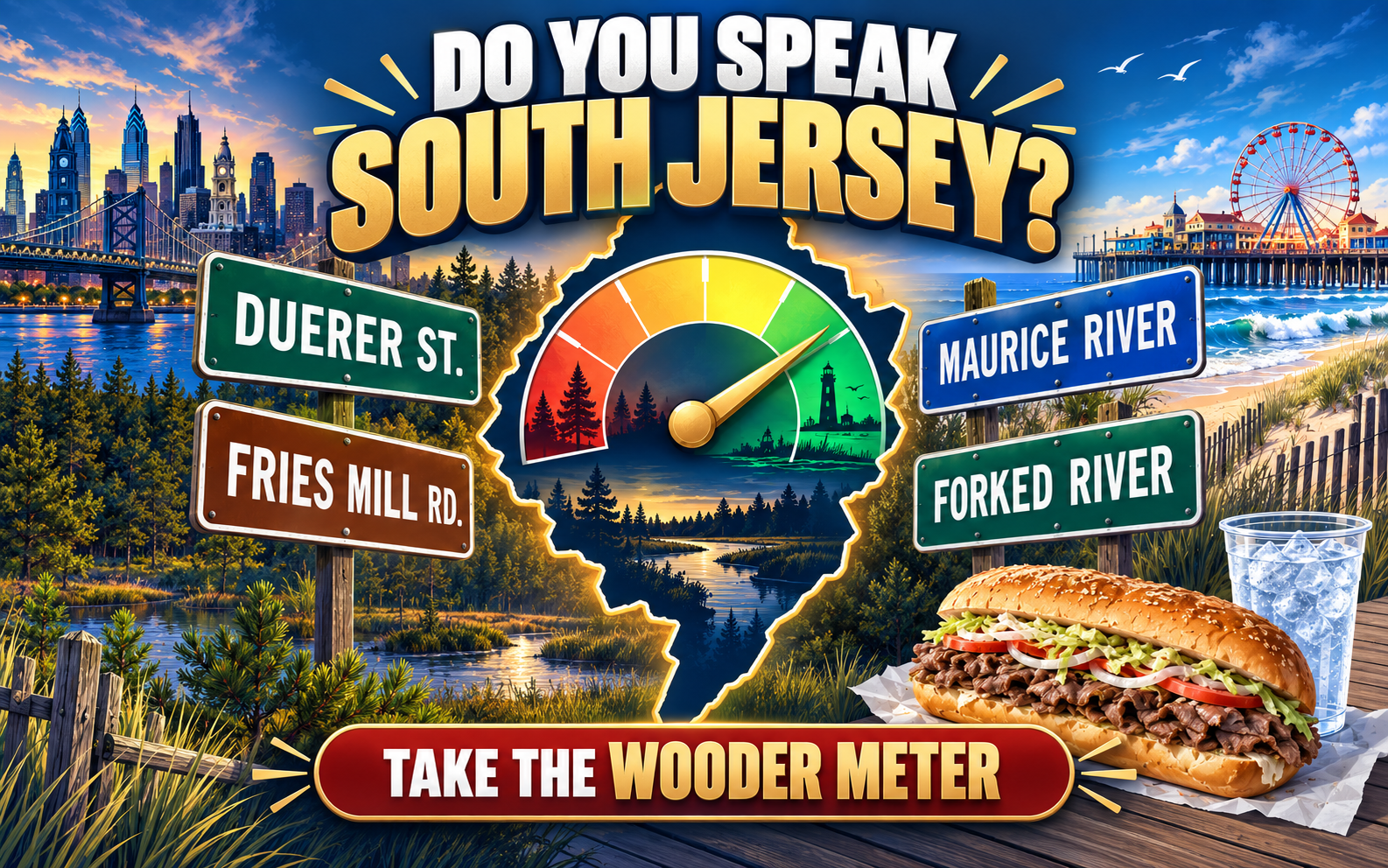
Every part of the country has words that reveal where someone grew up. In South Jersey, sometimes all it takes is one glass of water. Or should I say one glass of "wooder"? That famous regional pronunciation recently inspired a meme showing an airline passenger being duct-taped to his seat after repeatedly asking for a bottle of "wooder" instead of water. According to the joke, he was eventually exonerated when authorities discovered he was from the Jersey Shore.
Obviously, nobody is really getting restrained for saying "wooder." Around here, that pronunciation may actually help prove your local credentials. But where did "wooder" come from? Why do longtime residents pronounce certain South Jersey street names differently than newcomers? And how did roads such as Duerer Street and Fries Mill Road acquire pronunciations that do not seem obvious from their spelling?
Welcome to the unofficial South Jersey pronunciation guide, where the spelling is sometimes only a suggestion. The South Jersey pronunciations you hear every day are a window into who settled here, how families passed their speech down and what it really means to talk like a local.
The Wooder Meter
The Wooder Meter
How Philly/South Jersey Are You?
Think you speak fluent South Jersey? Put down your glass of wooder and take the Wooder Meter. We'll test your knowledge of local pronunciations, expressions and foods—and tell you just how Philly/South Jersey you really are.
12 questions. No studying required. Wawa experience may help.
Question 1 of 12
Your Wooder Meter Result
How you did
BONUS QUESTION: THE GREAT BUENA DEBATE
How do you pronounce Buena?
Whether you scored as a lifelong local or a Turnpike Tourist, I can help you find your place in South Jersey—from the Pine Barrens to the Jersey Shore.
Why Do Philadelphians and South Jersey Residents Say "Wooder"?
"Wooder" is one of the most recognizable features of the traditional Philadelphia accent. Linguists usually represent the pronunciation more precisely than the humorous spelling suggests. The first vowel in "water" is raised and pronounced farther back in the mouth than it is in standard American English. The "t" between vowel sounds also becomes a quick tap that sounds much like a soft "d." Put those two features together and "water" begins to sound like "wooder."
It is not simply a case of people deliberately replacing a "t" with a "d." Similar tapping happens in ordinary American pronunciations of words such as "butter," "city" and "better." The distinctive Philadelphia-area vowel is what makes "wooder" especially noticeable.
The Philadelphia dialect developed over generations through regional settlement patterns and the mixture of communities throughout southeastern Pennsylvania, South Jersey, Delaware and portions of Maryland. Philadelphia became one of the most extensively studied dialect areas in the United States, thanks largely to the work of University of Pennsylvania linguist William Labov and other researchers. If you want to dig deeper, a look at the wooder pronunciation from the Grammarphobia language blog and this overview of Philadelphia English on Wikipedia are both worth a read.
South Jersey naturally shares many of these speech patterns because of its geographic, cultural and economic connection to Philadelphia. Television stations, radio, sports, family connections and generations of people moving across the Delaware River have all helped create a recognizable Delaware Valley way of speaking. That is why "wooder" does not stop at the Ben Franklin Bridge. You can hear it in Camden County, Gloucester County and Atlantic County, and, yes, down the Jersey Shore.
"Wooder" Is More Than an Accent
Regional pronunciations are often treated as mistakes, but linguistically, an accent is not defective English. It is a systematic way of speaking shared by a community. When South Jersey residents say "wooder," "Iggles" for Eagles or "beggle" for bagel, they are following speech patterns absorbed from family members, neighbors and the surrounding culture.
These pronunciations also carry a sense of identity. Someone might soften their accent at work, while traveling or when speaking publicly. Put that same person at a backyard barbecue, an Eagles game or a Wawa counter, and the full hometown accent may suddenly return. Ask them if they want ice in their wooder and see what happens.
Duerer Street: Is It "Deer," "Doer" or "Durer"?
Duerer Street runs through portions of the Egg Harbor City and Galloway Township area and is one of those road names that can immediately separate longtime locals from people following a navigation app. If you want the full picture of both towns, the Egg Harbor City community guide and the Galloway Township community guide are a great place to start.
Many people encountering the name for the first time attempt to pronounce every letter: "Doo-er-er." Others shorten it to "Do-er" or "Dure-er." However, many longtime area residents traditionally pronounce the street more like "Deer." That local pronunciation is part of the road's identity, even though it differs from the way the name of German Renaissance artist Albrecht Dürer is usually pronounced in English or German.
The street's name connects to Egg Harbor City's fascinating German history. Egg Harbor City was founded in the 1850s as a planned settlement for German immigrants. Its street plan reflected the ambitions and cultural identity of its founders, and the town's social life grew up alongside those streets, as you will see in our look at Egg Harbor City's bar history. Some streets were named for American cities with substantial German populations, others for European cities, and another group honored notable figures from German and European history and culture.
Duerer Street is associated with Albrecht Dürer, the celebrated German Renaissance painter and printmaker. The umlaut in "Dürer" could also be written as "ue," producing "Duerer." For the street-by-street story, a detailed look at Egg Harbor City's street-name history is a fascinating read, and the Metropolitan Museum of Art's biography of Albrecht Dürer fills in the artist behind the name.
Over time, however, names frequently change when they enter everyday local speech. The historically inspired German name became a South Jersey road name, and residents developed their own way of saying it. For practical purposes, the most useful rule may be: if you say "Deer Street" and the local resident knows exactly where you mean, you have said it correctly for the neighborhood. Because local pronunciations are passed down orally and may vary among families and generations, you may still hear "Doer" or another variation. That disagreement is part of what makes the name interesting.
Fries Mill Road Does Not Rhyme With French Fries
Fries Mill Road is another South Jersey pronunciation trap. Newer residents and visitors naturally read the name as "Fries Mill Road," with "fries" pronounced like the food. Historically, however, longtime residents have pronounced Fries like "Freeze," rhyming with "trees."
This is not merely a quirky attempt to make the road sound different. Fries is a family surname, and "Freeze" is a recognized pronunciation of that surname. The name is also connected to the historic Fries Mill and the surrounding mill settlement. Remnants of the old sawmill and gristmill community can still be found in the Pine Barrens near the Manumuskin River Preserve in Cumberland County.
The Fries Mill name later became attached to the familiar roadway extending through portions of Gloucester and Camden counties. As new residents arrived, and GPS directions began reading names exactly as spelled, the French-fry pronunciation became increasingly common. Longtime residents still know it as "Freeze Mill Road."
This gives South Jersey directions a wonderful built-in test: if someone tells you to take "Freeze Mill Road," they probably learned the name from another local. If they tell you to turn onto "French Fries Mill Road," they may be reading it from their phone.
Maurice River Is Pronounced "Morris"
South Jersey's unusual pronunciations extend beyond street names. The Maurice River and Maurice River Township in Cumberland County are traditionally pronounced "Morris," not "More-EECE." Even the National Wild and Scenic Rivers System's Maurice River page identifies the river as the Maurice, pronounced "Morris," River.
The river is one of South Jersey's major natural treasures, flowing through wetlands and forests that provide internationally important habitat for migratory birds, fish and other wildlife. The pronunciation may surprise visitors, but saying "Morris River" is one of the easiest ways to sound like someone who knows Cumberland County.
Forked River Has Two Syllables
Farther north along the Jersey Shore is Forked River. Visitors often pronounce it "Forkt River," treating "forked" as a one-syllable word. Locals generally call it "FOR-kid River." The two-syllable pronunciation is so closely associated with the community that saying "Forkt River" can immediately identify someone as an outsider.
It is a good reminder that local place names do not always follow the pronunciation rules we use in ordinary conversation. A forked tree may be "forkt," but Forked River is "FOR-kid." Welcome to New Jersey.
Buena May Be South Jersey's Greatest Pronunciation Debate
Then there is Buena. Depending on whom you ask, you may hear "BYOO-nuh," "BYOO-nah," "BWAY-nuh," "BWAY-nah" or another locally familiar variation. Buena Borough and Buena Vista Township have generated decades of good-natured pronunciation debates.
Different families and communities may defend slightly different versions, and each may insist theirs is the only correct one. That makes Buena less of a pronunciation rule and more of a South Jersey conversation starter. The safest strategy may be to listen to how the person you are speaking with says it and follow their lead.
The Accent Is Only Part of the Language
South Jersey speech is not limited to pronunciation. We also have expressions that can confuse people from outside the region.
"Down the Shore"
In most places, people go "to the beach." In New Jersey, we go "down the shore," even if the trip involves traveling north. "The shore" can refer to the beaches, barrier islands, boardwalks and coastal communities collectively. You may go down the shore for the day, stay down the shore for a week or own a home down the shore. The expression is geographic, cultural and emotional all at once.
"Youse"
"Youse" or "youse guys" serves as a plural form of "you." English technically uses "you" for both one person and several people, but that can be inconvenient. The South solved the problem with "y'all." Parts of the Delaware Valley solved it with "youse." It may not appear in a formal business letter, but everyone knows what it means.
"Jeet Yet?"
This famous Philadelphia-area phrase compresses an entire question into two words: "Did you eat yet?" A perfectly acceptable response is: "No, did you?" Which may sound something like: "No, jew?" At that point, someone is probably ordering a hoagie.
Hoagies, Jimmies and Water Ice
The regional vocabulary is just as revealing as the accent. A long sandwich is a hoagie, not automatically a sub. Chocolate sprinkles on ice cream may be called jimmies. And water ice is pronounced "wooder ice," a phrase that can sound wonderfully confusing to anyone visiting from another part of the country. Calling it "Italian ice" may describe the general category, but it does not carry the same hometown feeling.
Why Local Pronunciations Matter in Real Estate
Local language may seem like a small detail, but it tells a larger story about a community. Street names preserve the people, industries and immigrant cultures that shaped an area. Pronunciations reveal how those names were handed down from one generation to the next.
They also matter practically. When buyers are unfamiliar with the area, they may not realize that the road pronounced by a resident is the same road appearing differently on a map. A buyer searching for "Deer Street" might not immediately recognize Duerer Street. Someone hearing "Freeze Mill Road" may expect it to be spelled Freeze rather than Fries. Knowing these differences is part of knowing the communities you serve.
Real estate is not only about bedrooms, bathrooms and square footage. It is also about understanding the small local details that help a place feel like home.
Are Regional Accents Disappearing?
Regional speech is always changing. Research into the Philadelphia dialect indicates that some of its most recognizable features have become less pronounced among younger or more mobile speakers. People hear national speech patterns constantly through television, social media, schools and workplaces. People may also consciously change their speech after being teased or corrected.
Still, accents rarely disappear completely. They evolve. Even someone who speaks with little noticeable accent may use a stronger local pronunciation around family or childhood friends. Certain words, especially water, can survive long after other accent features have faded. And local place names can be even more durable. Once generations of residents agree that a street is pronounced a certain way, the local version may continue regardless of what the spelling or navigation system suggests.
The Unofficial South Jersey Pronunciation Test
How would you pronounce these? Water: "Wooder." Duerer Street: traditionally "Deer" among many longtime locals. Fries Mill Road: "Freeze Mill Road." Maurice River: "Morris River." Forked River: "FOR-kid River." Buena: you may want to ask the nearest resident before taking sides.
If those answers came naturally, congratulations: your South Jersey credentials are looking pretty good. If not, do not worry. Stop at Wawa, order a hoagie and a bottle of wooder, and someone will help you out.
What Did Your Family Call It?
Local pronunciations are passed along through conversation, not instruction manuals. That means residents sometimes remember the same road, town or landmark differently. How did your family pronounce Duerer Street or Fries Mill Road? Are there other South Jersey street names, towns or expressions that immediately reveal whether someone is a local?
Share your memories and favorite examples. They may become part of a future guide, because South Jersey pronunciations are a shared, living tradition. And if you are thinking about buying or selling a home anywhere from the Pine Barrens to the Jersey Shore, contact Derek Doernbach. Knowing how to pronounce the street may not be required, but knowing the community certainly helps.
About the Author
Derek Doernbach is a South Jersey real estate professional with Century 21 Action Plus Realty and leader of Your Jersey Shore Team. He serves buyers and sellers throughout Atlantic County, Cape May County, Ocean County and surrounding South Jersey communities.
If you are buying or selling anywhere in the region, he would love to hear from you. Reach out through the contact page.
Frequently Asked Questions
Here are quick answers to the South Jersey pronunciation questions readers ask most often.
Why do people in Philadelphia say "wooder"?
The word "water" in the traditional Philadelphia accent has its first vowel raised and moved farther back in the mouth, and the "t" becomes a quick tap like a soft "d." Together those features make "water" sound like "wooder."
Do people in South Jersey also say "wooder"?
Yes. South Jersey shares much of the Philadelphia accent because of its strong geographic, cultural and economic connection to Philadelphia, so "wooder" can be heard across Camden, Gloucester and Atlantic counties and down the shore.
How do locals pronounce Duerer Street?
Many longtime residents traditionally pronounce Duerer Street like "Deer," though "Doer" and other variations are also heard. The name comes from German Renaissance artist Albrecht Dürer, but the local pronunciation has its own identity.
How is Fries Mill Road pronounced?
Longtime residents historically pronounce Fries like "Freeze," so the road is "Freeze Mill Road." The "fries"-like reading is common among newcomers and GPS directions.
How do you pronounce Maurice River, New Jersey?
The Maurice River and Maurice River Township are traditionally pronounced "Morris," not "More-EECE." The official National Wild and Scenic Rivers listing also notes the "Morris" pronunciation.
How do New Jersey locals pronounce Forked River?
Locals generally pronounce it "FOR-kid River" with two syllables, while visitors often say "Forkt River."
What does "down the shore" mean?
"Down the shore" is how New Jerseyans refer to going to the beach and coastal communities. It is used for day trips, vacations or owning a home at the Jersey Shore.
Is the Philadelphia accent disappearing?
Research suggests some of its most recognizable features have faded among younger and more mobile speakers, but accents evolve rather than vanish. Certain words like "wooder" and many local place-name pronunciations are especially durable.
Filed under
Talk to you soon. Whether you are buying, selling, relocating or simply exploring your options across South Jersey and the Jersey Shore, honest guidance and clear communication make all the difference.