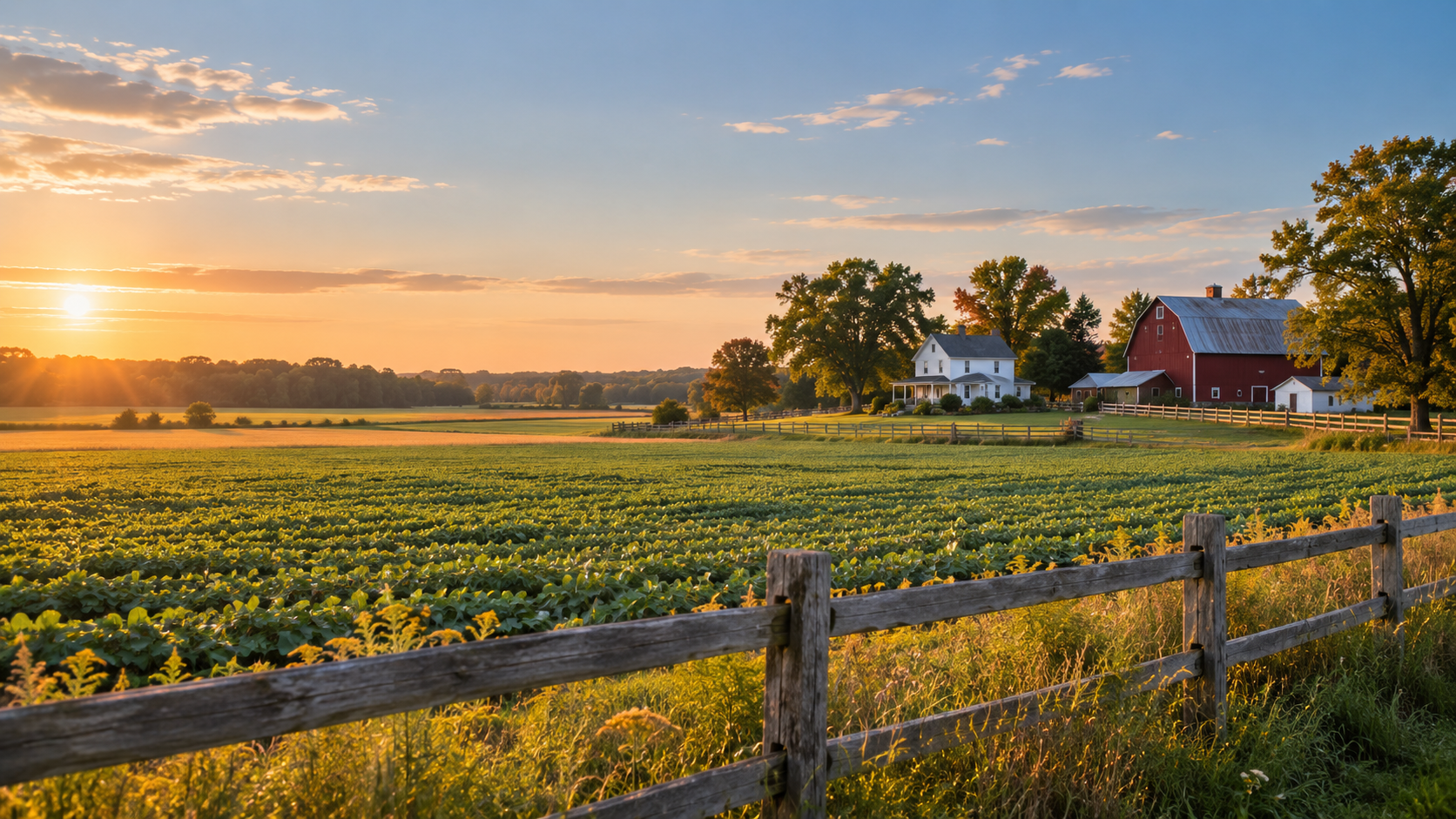
Buying a Farm or Acreage in South Jersey: What Buyers Need to Know

Derek Doernbach, REALTOR®
Published September 12, 2026 · 19 min read
Buying 12, 15, 25 or more acres is fundamentally different from purchasing a conventional residential home. I see it on nearly every farm and acreage search I run for buyers in Atlantic County and Cumberland County: the same excitement about a property, followed by a long list of questions a typical house hunt never raises.
When buyers start looking at rural property, they often picture a working family farm, horses, livestock or poultry, crop production, greenhouses or nurseries, a multigenerational homestead, a farm stand, pick-your-own crops, hayrides and seasonal events, workshops and barns for equipment, subdividing part of the land, or simply long-term privacy and open space.
Here is what I tell every one of those buyers: none of those uses should be assumed just because a listing describes a property as a “farm,” “farmette,” “horse property,” “agricultural,” “rural,” or “acreage.” So what should you look for when buying a farm in New Jersey? Before buying a farm or acreage in South Jersey, investigate the property’s municipal zoning, permitted uses, farmland-preservation status, deed restrictions, Pinelands designation, wetlands, flood zones, soils, septic capacity, well and irrigation resources, road frontage, access, surveys, environmental history and eligibility for farmland assessment. Confirm that your intended residences, livestock, buildings and agritourism activities are actually permitted before you complete the purchase.
Quick Answer: What should I look for when buying a farm in New Jersey?
Start with the property’s legal and physical facts, not its marketing. Check municipal zoning and permitted uses, whether the land is preserved, farmland assessed, or subject to Pinelands, wetland and flood restrictions, and confirm soils, septic capacity, wells, road access and a current survey. Verify that the specific uses you have in mind, such as a second residence, livestock or a farm business, are permitted before you make an offer.
This guide walks through what a “farm” actually means in a listing, the difference between preserved and unpreserved land, farmland assessment, Pinelands and environmental rules, water and septic systems, multiple dwellings, livestock, agritourism, financing, and how to run a thorough search across Atlantic and Cumberland counties.
What Does “Farm” Mean in a Real Estate Listing?
Terms like “farm,” “farmette,” “gentleman’s farm,” “horse property,” “rural residential,” and “agricultural property” show up often in listings. In many cases they are marketing descriptions rather than definitive legal classifications. A seller or an agent may use “farm” loosely to describe a large lot with a barn, a former farmhouse on a few acres, or land that was last farmed decades ago.
It helps to separate the categories that all sit under that one word:
- Land currently being farmed
- Land located in an agricultural zoning district
- Land receiving New Jersey farmland assessment
- Permanently preserved farmland
- Unpreserved farmland
- A residential property with substantial acreage
- Vacant land that might be suitable for agriculture
- A commercial farm for Right to Farm purposes
These categories can overlap, but they are not interchangeable. A property can be farmed today and still have no agricultural zoning. A parcel can qualify for farmland assessment and still carry a preservation easement. Knowing which category a property actually falls into is the first step in a serious farm purchase.
Preserved vs. Unpreserved Farmland
This is the distinction I spend the most time on with rural buyers, because it shapes everything else about a property.
Preserved farmland
When a farm is permanently preserved, its development rights have generally been restricted through a recorded development easement. The property remains privately owned and can be sold, but the restrictions run with the land and bind every future owner. A lower purchase price does not mean you may later develop or subdivide it like unrestricted land.
Buyers must review the actual recorded deed of easement, because it may address permitted agricultural uses, existing and future residences, residential exception areas, agricultural labor housing, buildings and impervious coverage, subdivision restrictions, nonagricultural activities, resource extraction, soil disturbance, and commercial or event-related activities.
Unpreserved farmland
“Unpreserved” generally means the owner has not permanently sold or conveyed the property’s development rights through a farmland-preservation easement. That does not automatically mean the land is buildable, subdividable, suitable for multiple homes, or free of other restrictions.
Unpreserved does not mean unrestricted. Other limitations can include zoning, minimum lot area, density rules, Pinelands regulations, wetlands, septic limitations, flood hazards, conservation easements, access limitations and private deed restrictions.
Agricultural Zoning
Zoning is controlled primarily at the municipal level, and the zoning district shown in a tax record or listing is only the beginning of the analysis. Buyers should obtain or confirm:
- The current zoning designation
- The permitted principal uses
- Permitted accessory uses
- Conditional uses
- Minimum lot area and lot width
- Required setbacks
- Maximum lot coverage
- Rules for barns, greenhouses, farm stands and accessory buildings
- Livestock or animal regulations
- Parking, lighting and signage standards
- Whether commercial events or agritourism require approvals
- Whether any existing structures or uses are legally nonconforming
- Whether prior variances, resolutions or site-plan approvals affect the property
Ask the zoning official about your exact proposed use in writing. “Agriculture permitted” does not necessarily answer whether a wedding venue, commercial kitchen, petting zoo, brewery, farm store, riding facility, campground or second residence is permitted.
Farmland Assessment Is Not Farmland Preservation
This may be the most misunderstood topic in rural New Jersey real estate, and it matters because it affects your property taxes.
New Jersey’s general farmland-assessment requirements currently include:
- At least five contiguous acres devoted to qualifying agricultural or horticultural use, excluding the farmhouse and land actually used in connection with the residence
- Agricultural or horticultural use for at least the two consecutive years preceding the tax year
- Average annual gross sales, qualifying payments or fees of at least $1,000 for the first five acres, plus $5 for each additional acre of agricultural or horticultural land
- For qualifying woodland or wetland under an approved Woodland Management Plan, at least $500 for the first five acres, plus 50 cents for each additional acre
- An annual application filed with the municipal tax assessor on or before August 1 of the pretax year
- Continued qualifying use through the end of the applicable tax year
Woodland and Forest Stewardship situations can involve additional plans, filings and eligibility requirements. Buyers should confirm the property’s present qualification and continued eligibility with the municipal tax assessor and the appropriate agricultural or forestry professionals.
Because income thresholds and filing deadlines can change, verify the exact current figures through the official farmland assessment guide or the farmland assessment overview from the New Jersey Department of Agriculture before relying on them.
Rollback taxes are the other side of this. If qualifying land is converted to a nonagricultural use, rollback taxes may be imposed for the year of change and the two preceding tax years. A sale or transfer of ownership does not, by itself, trigger rollback taxes if the new owner continues the qualifying agricultural or horticultural use. Rollback liability generally arises when land receiving farmland assessment is changed to a nonagricultural use. Because the liability attaches to the land when the change in use occurs, buyers should have their attorney and tax professional evaluate the intended use, potential amount and contractual allocation of any rollback taxes. I cover the broader topic of fighting an unfair assessment in my South Jersey property tax appeal guide.
Keep the core point in mind: a property can be farmland assessed without being preserved, and preserved farmland may also receive farmland assessment, but the two programs serve different purposes.
| Type of property | What it means | What buyers should know |
|---|---|---|
| Preserved farmland | Development rights restricted by a recorded easement that runs with the land. | Can be sold, but development and subdivision are limited. Review the recorded easement. |
| Unpreserved farmland | Development rights have not been permanently conveyed through preservation. | More flexibility in theory, but zoning, Pinelands, wetlands and deed rules still apply. |
| Farmland-assessed property | A property-tax classification for land in qualifying agricultural or horticultural use. | Lowers taxes; it is not preservation. Conversion can trigger rollback taxes. |
| Rural residential acreage | A residential property with substantial land that may or may not be farmed. | Confirm permitted uses, septic capacity and whether any agricultural claim is accurate. |
Pinelands, Wetlands and Environmental Limitations
Substantial portions of Atlantic and Cumberland counties are within the New Jersey Pinelands Area. A large parcel in the Pinelands may carry significant limitations based on its management area, development density, septic requirements, wetlands, threatened or endangered species habitat and other environmental standards.
Buyers should investigate:
- Pinelands management-area designation
- Any prior Pinelands applications or approvals
- Whether development rights or Pinelands Development Credits have been severed
- Freshwater wetlands and transition areas
- Flood Hazard Area controls
- CAFRA applicability where relevant
- Known contaminated sites
- Former fuel tanks
- Pesticide or fertilizer storage
- Farm dumps or buried debris
- Historic machinery-maintenance areas
- Former nurseries, orchards or intensive agricultural uses
- Conservation, drainage or utility easements
Online mapping is an initial screening tool, not a final determination. Formal agency determinations and professional evaluations may be necessary. The Pinelands Development Credit fact sheet explains one of the key mechanisms, and the New Jersey Department of Environmental Protection handles wetlands and flood hazard oversight.
Usable acres can matter more than total acres. A 20-acre parcel with extensive wetlands, poor soils or limited development rights may offer less flexibility than a smaller parcel with suitable uplands, road frontage and documented approvals.
Soils, Septic Systems, Wells and Water
Rural South Jersey properties often require private wells and septic systems because they sit outside public water and sewer service areas. That makes water and wastewater one of the most important parts of farm due diligence.
Look carefully at:
- Existing septic records and approvals
- Septic inspections
- Soil suitability and seasonal high-water tables
- Percolation or soil testing where applicable
- Whether a system can support the desired number of bedrooms
- Whether additional residences would require separate approvals
- Well-water quality and yield
- Irrigation capacity
- Saltwater intrusion or water-quality issues where applicable
- Agricultural irrigation permits or water-allocation questions for higher-volume use
- Drainage patterns, ditches and standing water
- The difference between land that looks dry during one visit and year-round site conditions
A listing advertising six bedrooms across multiple structures does not necessarily prove that the septic system was approved for that capacity.
Multigenerational Farm and Multiple Dwellings
Many buyers searching for acreage want to live with parents, adult children or extended family on one property. Owning 12 to 15 acres does not automatically permit:
- Two detached homes
- An accessory dwelling unit
- An apartment in a barn
- A converted outbuilding
- A mobile or manufactured home
- Farm-labor housing
- Subdivision for a relative’s home
Buyers should confirm zoning, Pinelands requirements, septic capacity, building-code compliance, legal occupancy, deed restrictions and any preservation-easement restrictions. A property with two existing houses still requires investigation into whether both homes are legally established, have certificates of occupancy where applicable, and have approved water and wastewater systems.
Livestock, Horses and Farm Infrastructure
If horses, cattle, goats, sheep, pigs, chickens or other poultry, or a kennel or breeding operation is part of the plan, add these to your due-diligence list:
- Local animal ordinances
- Zoning requirements
- Acreage or setback standards
- Fencing
- Pasture quality
- Water access
- Manure storage and management
- Barn condition
- Electrical and fire safety
- Equipment access
- Soil erosion
- Neighboring residential uses
- Existing agricultural leases or tenant farmers
The New Jersey Right to Farm Act program provides important protections for qualifying commercial farms operating in compliance with applicable standards, but it is not a blanket exemption from zoning, environmental, health, safety or other laws. Don’t assume that calling an activity “farming” overrides local requirements. If horses are part of your plan, Rutgers Cooperative Extension’s horse farm fact sheet is a practical starting point for stewardship and site planning.
Agritourism and Farm-Based Businesses
Agritourism is the broad term for public-facing farm activities: pick-your-own crops, pumpkin patches, hayrides, corn mazes, educational farm tours, seasonal festivals, farm-to-table events, workshops, petting farms, farm stays, weddings or private events, and roadside markets and farm stores.
A farm’s agricultural use does not automatically authorize every public-facing activity. Buyers should investigate whether the proposed activity is permitted, any conditional-use or variance requirements, site-plan approval, parking and traffic, fire-code and occupancy rules, food-service and health approvals, restrooms and wastewater capacity, accessibility requirements, noise, lighting and signage, alcoholic-beverage rules, insurance and liability, hours and seasonal limitations, and deed-easement restrictions on preserved farms.
I can’t make a blanket statement about a particular activity here. The answer depends on the municipality’s ordinance and the property’s own documents, so review both before you commit to a business plan.
Access, Frontage, Surveys and Title
Don’t rely only on tax maps or aerial photographs. For a large or irregular rural parcel, title work and a current survey can be especially important. Work through:
- Boundary surveys
- Road frontage
- Legal access
- Landlocked parcels
- Shared driveways
- Paper streets
- Farm lanes
- Rights-of-way
- Utility easements
- Drainage easements
- Conservation easements
- Pipeline or transmission-line easements
- Encroachments
- Existing farm leases
- Hunting agreements
- Crop rights
- Timber rights
- Rights of first refusal
- Prior subdivisions
- Whether development rights have already been transferred or extinguished
Financing a Farm or Rural Property
Financing can differ from a standard residential mortgage. Possible complications involve large acreage, multiple dwellings, income-producing agricultural uses, outbuildings, mixed residential and commercial use, property condition, preserved farmland, vacant land, nonconforming structures, appraisal comparables, private roads and failed septic systems.
Depending on the property and intended use, buyers may need to investigate conventional residential financing, land loans, construction financing, agricultural lenders, Farm Credit institutions, USDA programs or commercial financing. I can’t promise eligibility for any particular program. The practical step is to consult lenders familiar with South Jersey agricultural and acreage properties before making an offer. If you are new to the buying process in this area, my buying guide walks through the early steps any buyer should take.
On-Market and Off-Market Farm Searches
Farm and acreage opportunities are not always marketed through ordinary residential searches. Potential sources include:
- Residential MLS listings
- Commercial and land listings
- Farm-specialty brokers
- County farmland-preservation programs
- Local agricultural networks
- Auctions
- Estate sales
- Attorneys and professional contacts
- Direct owner outreach conducted lawfully and respectfully
- Properties leased to neighboring farmers
- Owners planning retirement
- Parcels assembled from multiple lots
“Off-market” does not mean discounted, unrepresented, problem-free or immediately available. Any private transaction still requires full due diligence, documentation and appropriate professional representation. Acreage purchases also call for extra caution about who actually owns the land, something I discuss in my article on vacant land scams in New Jersey.
The Atlantic County and Cumberland County Search Area
Buyers often search both counties for good reason. Atlantic County combines mainland communities, Pinelands areas, traditional agricultural land and access to the Atlantic City International Airport and regional highways. Cumberland County has a strong agricultural identity, larger rural areas and access to established farming communities.
I see real opportunities across communities with a rural or agricultural character in Atlantic County, including Hammonton, Mullica Township, Buena Vista Township, Buena Borough, Folsom Borough, Hamilton Township, Weymouth Township, Estell Manor, Egg Harbor City, Galloway Township and Egg Harbor Township. In Cumberland County, farming and rural opportunities appear in and around Vineland, Millville, Bridgeton, Deerfield Township, Upper Deerfield Township, Hopewell Township, Fairfield Township, Greenwich Township, Shiloh Borough, Stow Creek Township, Lawrence Township, Commercial Township, Maurice River Township and Downe Township. My Cumberland County seller’s guide covers that part of the region in more depth.
I want to be straight with you: inventory is limited, and individual properties vary considerably. Don’t assume that every part of either county is agricultural or suitable for farming. The Atlantic County and Cumberland County websites are useful starting points for records, boards and local resources.
Two practical points about the search itself. First, measure actual drive times rather than drawing only a mileage radius. Rural roads, seasonal shore traffic and access to services all change a commute in ways a straight-line map distance does not. Second, search by municipality, tax map and local place name, because mailing addresses do not always match municipal boundaries.
That is especially true around Mays Landing. Buyers who say they want acreage near Mays Landing are often describing a broader Hamilton Township search. Mays Landing is the Atlantic County seat and a community within the Township of Hamilton, not a separate municipality. Larger rural parcels may also appear in the Laureldale, Mizpah and unincorporated Weymouth areas of Hamilton Township—not to be confused with neighboring Weymouth Township—so an effective search should include local place names, municipal records and tax-map information rather than relying on the mailing city alone. You can see more in my Hamilton Township area guide and my Living in Mays Landing guide.
Buyer Due-Diligence Checklist
Use this checklist as your starting framework before you make an offer on any farm, acreage or rural property in South Jersey.
Property status
- Preserved or unpreserved
- Farmland assessed or conventionally assessed
- Recorded development easements
- Current agricultural leases
- Existing crop, timber or hunting rights
Intended use
- Type of farming
- Livestock
- Number of residences
- Farm employees
- Farm store
- Agritourism
- Events
- Equipment storage
- Future subdivision
Land and development
- Zoning
- Pinelands status
- Wetlands
- Flood zones
- Soils
- Usable uplands
- Road frontage
- Legal access
- Survey
- Easements
- Development rights
- Prior approvals
Buildings and systems
- Legal status of every dwelling
- Certificates and permits
- Barn and outbuilding condition
- Septic capacity
- Well quality and yield
- Electric service
- Heating systems
- Fuel tanks
- Irrigation
- Fire and code safety
Financial and operational
- Financing approval
- Property taxes
- Farmland-assessment eligibility
- Possible rollback taxes
- Insurance
- Equipment and improvement costs
- Farm-business plan
- Environmental testing
- Professional consultations
Red Flags to Watch For
- A seller or agent who calls everything “farming” without evidence of current agricultural use.
- A preserved farm marketed with hints of future subdivision or development.
- Multiple bedrooms or dwellings with no documentation of approved septic capacity or certificates of occupancy.
- Large acreage in a wetland-heavy or Pinelands-restricted area being sold on total acres rather than usable acres.
- No current survey, vague access descriptions, or reliance on tax-map lines for boundaries.
- Promises about agritourism, events, second homes or livestock that have not been confirmed with the zoning official in writing.
Questions to Ask Before Making an Offer
Bring these questions to your agent, the seller, the municipality and your attorney. If a seller cannot answer them, that is itself an answer.
- Is the property permanently preserved?
- Can I review the recorded preservation easement?
- Are any residential exception areas identified?
- Has the property’s development density been formally determined?
- Have any Pinelands Development Credits been severed?
- What uses are permitted in the zoning district?
- Is my exact intended agricultural use permitted?
- Are public events or agritourism allowed?
- Are multiple dwellings permitted?
- Are all existing dwellings and apartments legal?
- What bedroom capacity was approved for the septic system?
- Are there wetlands or transition areas?
- How many acres are realistically usable?
- Is there a current survey?
- Who is farming the land now?
- Is there a written agricultural lease?
- Who owns the current crops?
- Has the property received farmland assessment?
- Could my intended change in use after purchasing the property trigger rollback taxes?
- Are there underground tanks, dumps, pesticide-mixing areas or known contamination?
- Is there sufficient well and irrigation capacity?
- Can the property be financed under my intended loan program?
The Professional Team a Rural Purchase May Require
A specialized acquisition may require coordination among several professionals:
- A real estate agent familiar with acreage and agricultural searches
- A New Jersey real estate or land-use attorney
- Municipal zoning officials
- The county agriculture development board
- The State Agriculture Development Committee when applicable
- The New Jersey Pinelands Commission
- NJDEP or an environmental consultant
- A licensed surveyor
- A civil or septic engineer
- A well and septic inspector
- A soil scientist
- A tax professional
- An agricultural lender
- An insurance professional
- Rutgers Cooperative Extension or agricultural advisers
My role as your agent is to help identify issues, obtain records, coordinate due diligence and keep the transaction moving. I do not replace licensed legal, engineering, environmental or tax professionals, and I would never pretend otherwise.
Frequently Asked Questions About Buying Farm and Acreage in South Jersey
What is the difference between preserved and unpreserved farmland in New Jersey?
Preserved farmland has had its development rights permanently restricted through a recorded easement that runs with the land and binds future owners. Unpreserved farmland has not had those development rights conveyed, which generally leaves more flexibility, but unpreserved does not mean unrestricted. Zoning, Pinelands rules, wetlands, septic limits and deed restrictions can still limit what you can do with either type.
Does farmland assessment mean a property is preserved?
No. Farmland assessment is a property-tax classification for qualifying land actively devoted to agricultural or horticultural use, while preservation permanently restricts development rights through a recorded easement. A property can be farmland assessed without being preserved, and preserved farmland may also receive farmland assessment. The two programs serve different purposes, so never assume lower assessed taxes mean the land is protected from development.
Can I build a second home on a farm in New Jersey?
It depends entirely on the property. Owning 12 to 15 acres does not automatically permit a second detached home, an accessory dwelling unit, an apartment in a barn or a converted outbuilding. You must confirm municipal zoning, Pinelands requirements, septic capacity, building-code compliance, legal occupancy, deed restrictions and any preservation-easement restrictions before assuming a second residence is possible.
How many acres do I need to qualify for farmland assessment?
New Jersey farmland assessment generally requires at least five contiguous acres devoted to qualifying agricultural or horticultural use, excluding the acreage devoted to the farmhouse and residential improvements. The land must have been in qualifying use for the required prior period, and you must meet annual gross-sales, payment or income requirements and file an annual application with the municipal tax assessor. Verify current thresholds before relying on them.
Can I operate a wedding venue or agritourism business on a farm?
Maybe, but only if the municipality permits it. A farm’s agricultural use does not automatically authorize public-facing activities such as weddings, hayrides, corn mazes, farm stores or seasonal events. You may need a conditional use or variance, site-plan approval, parking, health, fire-code and wastewater approvals. Review the municipal ordinance and any deed-easement restrictions on preserved farms before committing.
Can preserved farmland be sold?
Yes. Preserved farmland remains privately owned and can be sold like any other property. What cannot be done is to develop or subdivide the land beyond what the recorded preservation easement allows. The easement runs with the land and binds every future owner, so buyers must review the actual recorded deed of easement to understand permitted agricultural uses, residences, buildings and any restrictions.
What are rollback taxes?
Rollback taxes are additional property taxes generally imposed when land receiving New Jersey farmland assessment is changed to a nonagricultural use. They ordinarily cover the year of the change and the two immediately preceding tax years. A sale alone does not trigger rollback taxes if the new owner continues the qualifying agricultural or horticultural use. Buyers should have their attorney and tax professional investigate potential liability before purchasing or changing the property’s use.
Does owning acreage mean I can keep horses or livestock?
Not automatically. Municipal animal ordinances, zoning requirements, acreage or setback standards, fencing, pasture quality, water access and manure management all apply. Some towns restrict where livestock can be kept or how many animals are allowed. The New Jersey Right to Farm Act protects qualifying commercial farms in compliance with standards, but it is not a blanket exemption from local, health, safety or environmental laws.
What should I investigate before buying land in the New Jersey Pinelands?
Start with the Pinelands management-area designation, any prior applications or approvals, and whether development rights or Pinelands Development Credits have been severed. Then evaluate freshwater wetlands and transition areas, flood hazards, septic requirements, threatened or endangered species habitat and overall development density. Online mapping is only a screening tool; formal agency determinations and professional evaluations may be necessary.
How can buyers find off-market farms in Atlantic or Cumberland County?
Off-market farm opportunities can come from residential and commercial listings, farm-specialty brokers, county farmland-preservation programs, local agricultural networks, auctions, estate sales, attorneys and professional contacts, or respectful direct owner outreach. Properties may be leased to neighboring farmers or owned by owners planning retirement. Remember that off-market does not mean discounted or problem-free, and any private transaction still needs full due diligence.
Where can buyers find acreage near Mays Landing?
Mays Landing is the Atlantic County seat and a community within the Township of Hamilton, not a separate municipality. Buyers searching for acreage near Mays Landing are often describing a broader Hamilton Township search. Larger rural parcels may appear in the Laureldale, Mizpah and unincorporated Weymouth areas of Hamilton Township—not to be confused with neighboring Weymouth Township. Search by local place names, municipal records and tax-map information rather than relying only on the mailing city.
Can one property accommodate a multigenerational family?
Possibly, but only if the property’s legal and physical systems support it. Zoning, Pinelands requirements, septic capacity, building-code compliance, legal occupancy, deed restrictions and preservation-easement restrictions all control whether multiple residences are possible. A property with two existing houses still requires verification that both homes are legally established, have certificates of occupancy where applicable, and have approved water and wastewater systems.
The Right Rural Property Matches Your Plan
The right rural property is not simply the parcel with the largest acreage or the most attractive barn. It is the property whose legal rights, physical characteristics, infrastructure and location support the buyer’s actual plans. Take the time to understand the land before you fall for the view.
If you are considering a farm, acreage, horse property, rural home or multigenerational property in Atlantic County or Cumberland County, Derek Doernbach can help you build a targeted search, investigate the property’s available records and coordinate the due-diligence process with the appropriate professionals.
Realtor to the Stars, where I make YOU the star of your own home buying and home selling reality. Reach out anytime, and we will figure out what the right property looks like for you.
Legal disclaimer: This article provides general real estate information and is not legal, tax, zoning, engineering, environmental, lending or agricultural advice. Requirements vary by property, municipality, proposed use and applicable deed restrictions. Buyers should confirm their plans with the appropriate governmental agencies and qualified professionals before purchasing or developing rural or agricultural property.
Derek Doernbach, REALTOR®
Century 21 Action Plus Realty | Your Jersey Shore Team
Derek Doernbach is a Jersey Shore REALTOR® serving South Jersey since 2016. He has closed 192 real estate transactions as a single agent, earned the New Jersey Realtors® Circle of Excellence Award every year since 2019, and serves as a Director with the Atlantic City & County Board of REALTORS. He combines innovative marketing, technology, and direct, honest guidance to help homeowners through buying, selling, and major life transitions. Learn more about Derek on his About page.